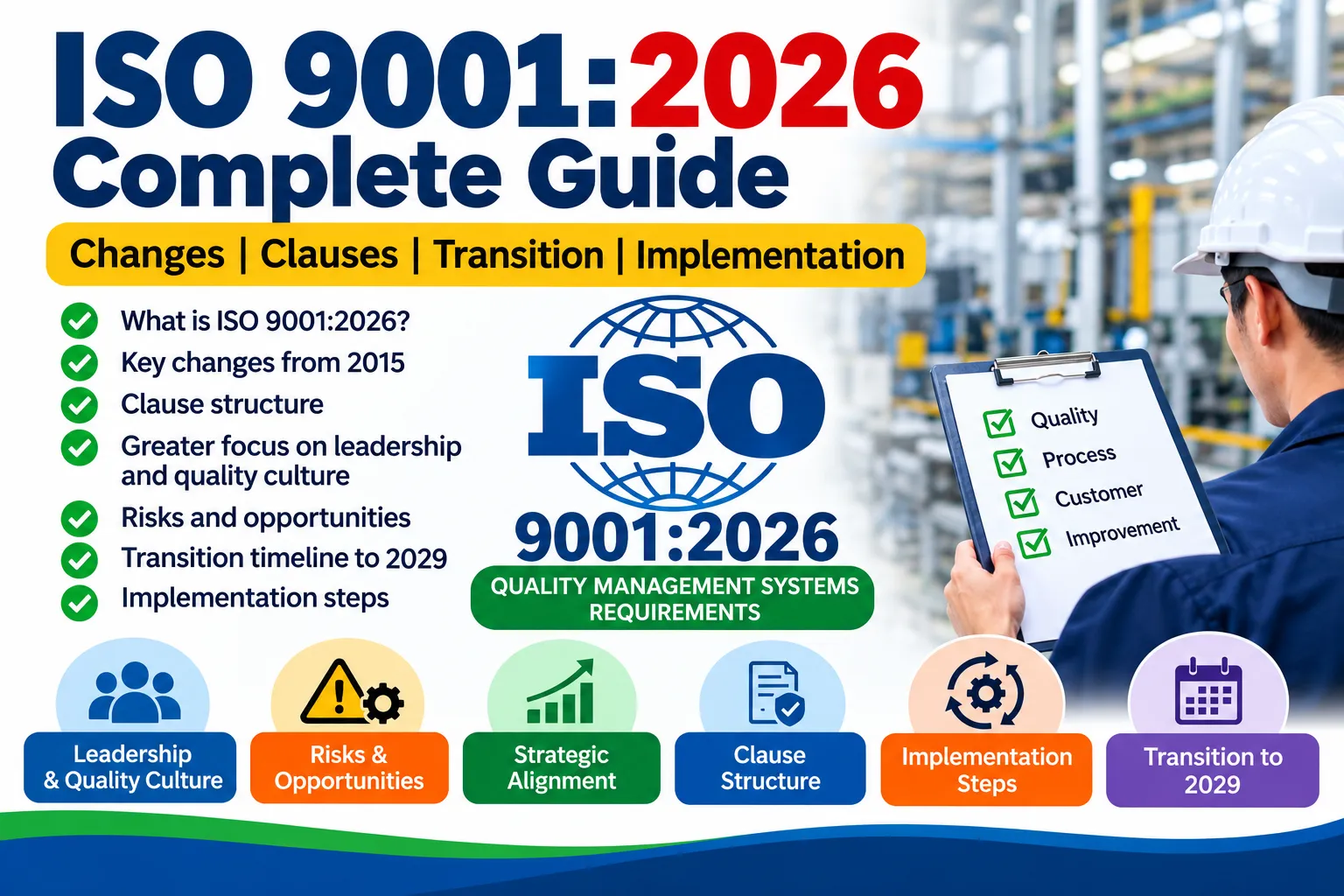
ISO certification is an important way for businesses to demonstrate their commitment to quality, consistency and customer satisfaction. In 2026, the publication of ISO 9001:2026 and the updated ISO 19011:2026 auditing guidelines have brought important changes for businesses. Organisations holding ISO 9001:2015 certification should understand the new requirements and plan their transition before the applicable deadline. This guide explains the latest ISO updates, key changes, certification process and practical steps businesses can follow.
Introduction
An ISO Certificate helps businesses demonstrate that their processes follow internationally recognised management system standards. It can improve customer confidence, strengthen internal operations and support businesses that want to work with larger companies, suppliers and international clients.
However, ISO certification requirements are evolving. One of the biggest developments in 2026 is the publication of ISO 9001:2026, the latest edition of the world's widely used quality management standard. It replaces ISO 9001:2015 and introduces updated guidance around leadership, quality culture, accountability and risk management.
Another important development is the publication of ISO 19011:2026, which provides updated guidelines for management system auditing. These developments make 2026 an important year for businesses that already hold an ISO certificate or are planning to apply for one.
Understanding these changes can help businesses prepare properly, avoid unnecessary delays and maintain an effective management system.
Latest ISO Certificate Updates in 2026: What Has Changed?
The most important ISO development in 2026 is the release of ISO 9001:2026. According to the International Organization for Standardization (ISO), the revised standard was published on 16 September 2026 and replaces the previous ISO 9001:2015 edition.
The objective is not to completely change the existing quality management framework. Instead, the revised standard improves clarity and strengthens areas that are increasingly important for modern businesses.
Here are the major updates businesses should understand:
1. ISO 9001:2026 Has Been Published
ISO 9001:2026 is the sixth edition of the quality management system standard. It continues the established framework but provides clearer wording and updated expectations.
The new edition places greater emphasis on:
-
Leadership involvement and accountability.
-
Building a strong quality culture.
-
Ethical behaviour within the organisation.
-
Better understanding of risks and opportunities.
-
Connecting quality management with business objectives.
-
Improving the usability of the standard.
Businesses should review their existing quality management systems to understand which processes need updating.
2. Updated ISO 9001 Transition Timeline
Businesses currently certified under ISO 9001:2015 should not ignore the new edition. A transition period has been established to give organisations time to understand and implement the updated requirements.
The published transition guidance includes these important dates:
| Transition milestone | Date |
|---|---|
| ISO 9001:2026 publication | 16 September 2026 |
| Accreditation bodies ready to assess the new edition | By 31 March 2027 |
| Certification bodies' transition declarations | By 30 June 2027 |
| Accreditation body transition decisions | By 30 September 2027 |
| New initial accredited certifications only to ISO 9001:2026 | From 31 March 2028 |
| Transition deadline for existing ISO 9001:2015 organisations | 30 September 2029 |
These dates are based on the published transition guidance. Businesses should confirm the arrangements and audit schedule with their own certification body.
3. ISO 19011:2026 – Updated Auditing Guidelines
Another important development is the publication of ISO 19011:2026 in May 2026.
ISO 19011 provides guidelines for auditing management systems, including quality and environmental management systems. It helps organisations plan audit programmes, conduct audits and evaluate auditor competence.
This standard is useful for businesses that conduct internal audits or prepare for external certification audits.
Important: ISO 19011 is an auditing guideline. It does not independently provide an ISO certificate to a business.
Official references:
Why Should Businesses Get an ISO Certificate in 2026?
Getting an ISO certificate is not just about displaying a certificate on an office wall. A properly implemented management system can help businesses improve their working processes and maintain consistent service or product quality.
Some important benefits include:
-
Better customer confidence: Customers can feel more confident when a business follows a recognised management system.
-
Improved process management: Documented procedures help employees understand their responsibilities.
-
Reduced operational errors: Regular monitoring and corrective actions can help identify problems early.
-
Business opportunities: Some corporate buyers, tenders and supply chains may require specific ISO certifications.
-
Better internal accountability: Defined roles and management reviews help businesses monitor performance.
-
Continual improvement: Regular reviews and audits help organisations identify areas that need improvement.
An ISO certificate does not automatically guarantee government approval, tender eligibility or business growth. Its value depends on the applicable standard, the organisation's actual implementation and the requirements of customers or buyers.
Which ISO Certificate Is Best for Your Business?
There is no single ISO certificate that is suitable for every business. The correct standard depends on the organisation's industry, activities, risks and business objectives.
Some commonly used ISO standards include:
| ISO Standard | Main Purpose | Suitable For |
|---|---|---|
| ISO 9001 | Quality Management System | Manufacturing, services, trading and other businesses |
| ISO 14001 | Environmental Management System | Businesses managing environmental impacts |
| ISO 45001 | Occupational Health and Safety | Organisations managing workplace safety |
| ISO 27001 | Information Security Management | IT companies and organisations handling sensitive information |
| ISO 22000 | Food Safety Management | Food manufacturers, processors and related businesses |
| ISO 13485 | Medical Device Quality Management | Medical device manufacturers and suppliers |
Before applying, identify the standard that matches your actual business activities. Applying for an unsuitable certification may increase costs without delivering meaningful business value.
How Can a Business Get an ISO Certificate in India?
The ISO certification process becomes easier when businesses prepare their documents and management systems in advance.
Follow these practical steps:
Step 1: Identify the Right ISO Standard
Choose the standard according to your business activities. For example, a company seeking a quality management system may consider ISO 9001, while an organisation handling sensitive information may need ISO 27001.
Step 2: Understand the Requirements
Review the requirements of the selected standard. Identify the policies, procedures, responsibilities and records your organisation needs to maintain.
Step 3: Prepare Business Documents
Common documents and information may include:
-
Business registration or incorporation documents.
-
PAN and business address details.
-
Details of products or services.
-
Organisation structure and employee responsibilities.
-
Quality or other applicable management policies.
-
Process documents and operational records.
-
Relevant internal audit and management review records.
The exact requirements depend on the selected ISO standard and certification scope.
Step 4: Implement the Management System
Prepare and implement the required processes. Employees should understand their responsibilities, and the organisation should maintain records showing that its system is being followed.
Step 5: Conduct an Internal Audit
Review whether the implemented system meets the applicable requirements. Identify gaps and take corrective action before the external certification audit.
Step 6: Select a Suitable Certification Body
Choose a competent certification body with appropriate accreditation and scope. Verify its credentials before proceeding. Do not assume that every organisation offering ISO certificates is an accredited certification body.
Step 7: Complete the Certification Audit
The certification body evaluates the management system through the applicable audit process. If nonconformities are identified, the organisation may need to address them before certification can be granted.
Step 8: Maintain Your Certification
After certification, continue following the management system requirements. Surveillance audits and periodic reassessments may apply according to the certification programme.
What Should Existing ISO 9001:2015 Certificate Holders Do Now?
If your business already holds an ISO 9001:2015 certificate, you do not need to start the entire certification process again simply because the new edition has been published.
Instead, follow these actions:
-
Obtain and review the ISO 9001:2026 requirements.
-
Compare the new edition with your existing quality management system.
-
Identify changes required in policies, procedures and records.
-
Train employees and relevant management personnel.
-
Update internal audit and management review processes.
-
Discuss the transition audit schedule with your certification body.
-
Complete the transition within the applicable deadline.
Starting early gives businesses more time to understand the changes and avoid last-minute preparation.
Common Mistakes to Avoid When Applying for ISO Certification
Businesses sometimes face delays or additional expenses because they do not prepare properly.
Avoid these common mistakes:
-
Choosing the wrong ISO standard: Always select a standard according to your actual business activities.
-
Using incomplete documents: Keep business details, policies and process records accurate.
-
Ignoring employee awareness: Employees should understand the procedures relevant to their work.
-
Treating certification as paperwork only: A management system must be implemented, not just documented.
-
Selecting an unsuitable certification provider: Verify the certification body's credentials and accreditation scope.
-
Ignoring surveillance audits: Certification requires continued compliance, not just one successful audit.
-
Delaying the 2026 transition: Existing ISO 9001:2015 certificate holders should plan ahead.
Frequently Asked Questions About ISO Certificate
1. Is ISO 9001:2026 the latest ISO certificate standard?
Yes. ISO 9001:2026 was published on 16 September 2026 and is the latest edition of the quality management system standard. It replaces ISO 9001:2015.
2. What is the last date to transition from ISO 9001:2015 to ISO 9001:2026?
The published transition guidance gives existing ISO 9001:2015 certified organisations until 30 September 2029 to complete the transition. Confirm the applicable arrangements with your certification body.
3. Is an ISO certificate mandatory for every business in India?
No. ISO certification is generally voluntary. However, specific customers, tenders, contracts or industry requirements may make a particular certification necessary.
4. How long does it take to get an ISO certificate in India?
The timeline depends on the selected standard, business size, complexity, documentation, implementation and audit requirements. There is no single fixed timeline for every organisation.
5. Can a small business or startup apply for ISO certification?
Yes. ISO management system standards can be used by organisations of different sizes, including startups and small businesses. The selected standard should match the organisation's activities and objectives.
Conclusion
The publication of ISO 9001:2026 and ISO 19011:2026 makes 2026 an important year for businesses focusing on quality management and compliance. Organisations already holding ISO 9001:2015 certification should start reviewing their systems and planning their transition instead of waiting until the deadline.
Businesses applying for the first time should select the correct standard, prepare their documentation and implement the required management system before the certification audit.
A properly implemented ISO management system can support better processes, customer confidence and continual improvement.
Get ISO Certification Support from CertifyKaro
Planning to apply for an ISO certificate or upgrade your existing ISO 9001:2015 certification?
CertifyKaro se contact karo for guidance on selecting the appropriate ISO standard, understanding documentation requirements and preparing for the certification process.
Call: +91 70422 52542
Website: /services/iso-certification
SEO Keywords to Target:
-
ISO Certificate
-
ISO Certification in India
-
ISO 9001:2026
-
ISO 9001 Certification
-
ISO Certificate Registration
-
ISO Certification Process
-
ISO Certification Requirements
-
ISO Certificate for Small Business
-
ISO Certification for Startups
-
ISO 9001:2015 to 2026 Transition
-
ISO 14001 Certification
-
ISO 27001 Certification
-
ISO 45001 Certification
-
ISO Certification Benefits
-
ISO Certification Cost in India
Suggested Internal Links:
Official External References: