Learn how DPIIT-recognised startups can receive up to ₹20 lakh as a grant and up to ₹50 lakh as debt or convertible debentures under the Startup India Seed Fund Scheme.
Startup India Seed Fund Scheme 2026: Eligibility & Benefits
Starting a business is exciting, but arranging funds at an early stage can be difficult. Many startups have innovative ideas but lack the money required to develop prototypes, test products or enter the market. The Startup India Seed Fund Scheme was introduced by the Government of India to address this early-stage funding gap and support promising entrepreneurs.
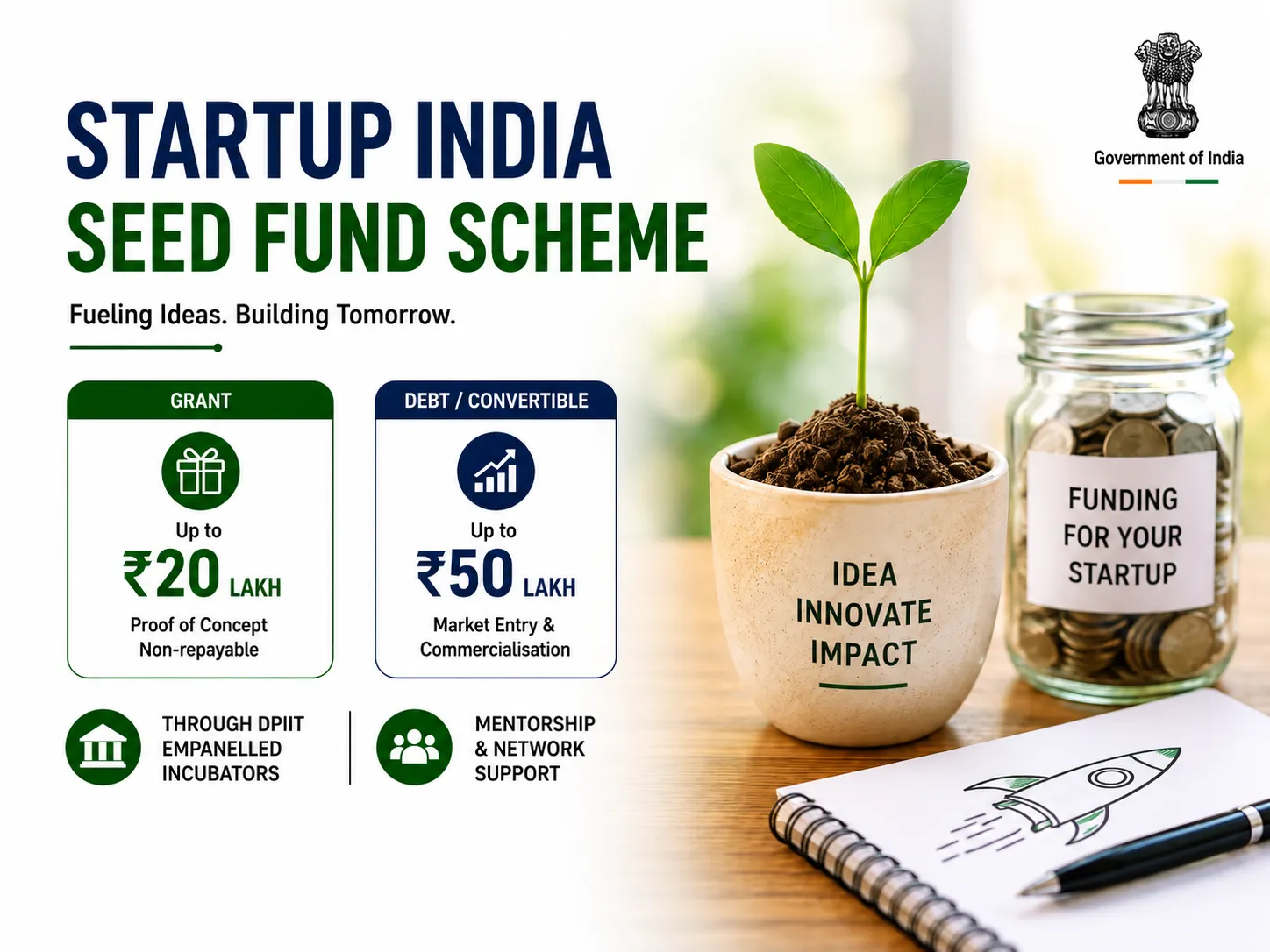
The scheme provides financial assistance to eligible startups through selected incubators. Startups can receive up to ₹20 lakh as a grant for proof of concept, prototype development or product trials, and up to ₹50 lakh through debt or convertible debentures for market entry and commercialisation.
A major government update in 2026 reported that the scheme's entire ₹945 crore corpus had been committed to 219 incubators, with more than ₹605 crore approved for over 3,400 startups. This guide explains the latest developments, eligibility criteria, funding benefits and application process.
What Is the Startup India Seed Fund Scheme?
The Startup India Seed Fund Scheme (SISFS) is a government initiative managed by the Department for Promotion of Industry and Internal Trade (DPIIT). It aims to provide early-stage financial support to startups that need funding to convert business ideas into market-ready products or services.
Unlike traditional business loans, the scheme provides assistance through selected incubators. These incubators evaluate applications, conduct due diligence and support selected startups with funding and mentoring.
Latest Startup India Seed Fund Scheme News in 2026
The government continues to report progress under its startup funding programmes. According to a Press Information Bureau update covering FY 2025–26:
-
219 incubators have been selected under SISFS.
-
The entire ₹945 crore scheme corpus has been committed.
-
More than ₹605 crore in funding has been approved for startups.
-
Over 3,400 startups have received funding approvals.
-
The scheme has been extended to enable continued disbursement and completion of approved activities.
This update is important for entrepreneurs because it shows the scale of funding approvals under the existing scheme. However, it should not be interpreted as confirmation that a fresh application window is open for every startup. Applicants should check the official portal for current application availability.
Another Major Funding Update: Startup India Fund of Funds 2.0
On 14 February 2026, the Union Cabinet approved Startup India Fund of Funds 2.0 with a corpus of ₹10,000 crore. Its purpose is to mobilise venture capital for deep-tech, technology-driven manufacturing and early-growth startups.
DPIIT subsequently issued operational guidelines on 25 April 2026. This is a separate funding mechanism that works through SEBI-registered Alternative Investment Funds (AIFs). It is not the same as SISFS and does not replace the seed fund application process.
These developments show that the government is using different funding mechanisms to support startups at different stages of business growth.
Official update: PIB – Startup India Fund of Funds 2.0
How Much Funding Can a Startup Receive Under SISFS?
The Startup India Seed Fund Scheme offers two types of financial assistance, depending on the startup's development stage and requirements.
1. Grant of Up to ₹20 Lakh
Eligible startups may receive a grant of up to ₹20 lakh for activities such as:
-
Validation of proof of concept.
-
Prototype development.
-
Product testing and trials.
-
Development of a product ready for market launch.
The grant is released in milestone-based instalments. Startups may need to submit progress updates and utilisation documents before receiving subsequent instalments.
2. Investment of Up to ₹50 Lakh
Startups may receive up to ₹50 lakh through convertible debentures, debt or debt-linked instruments for:
-
Market entry.
-
Commercialisation.
-
Scaling up business operations.
This assistance is not a grant. It is provided through the applicable debt or convertible instrument terms agreed with the incubator.
Important Funding Conditions
-
A startup can receive grant support and debt/convertible debenture support once each under the scheme guidelines.
-
The funding amount depends on the incubator's evaluation and the startup's requirements.
-
Funding is released according to agreed milestones and applicable terms.
-
The selected startup receives the funds in its company bank account.
For detailed conditions, refer to the official SISFS guidelines.
Who Is Eligible for the Startup India Seed Fund Scheme?
Not every newly established business can apply. The scheme has specific eligibility conditions that startups must meet.
1. DPIIT Recognition
The applicant must be recognised as a startup by DPIIT. Businesses that have not obtained DPIIT recognition should first check the official recognition process.
2. Age of the Startup
The startup must have been incorporated not more than two years before the date of application to the scheme.
3. Business Idea and Market Potential
The startup should have a business idea that can develop a product or service with:
-
Market fit.
-
Viable commercialisation.
-
Scope for scaling.
-
A clear solution to an identified problem.
4. Use of Technology
Technology should be used in the startup's core product, service, business model, distribution model or methodology to solve the problem being addressed.
5. Indian Promoter Shareholding
As per the scheme guidelines, Indian promoters must hold at least 51% shareholding in the startup at the time of application.
6. Previous Government Funding
The startup should not have received more than ₹10 lakh of monetary support under other Central or State Government schemes. Certain forms of support, such as prize money, subsidised working space, founder monthly allowance or access to laboratories, are treated separately under the scheme guidelines.
Applicants should review the full eligibility conditions before applying because meeting only one or two requirements does not guarantee selection.
How to Apply for the Startup India Seed Fund Scheme?
The application process is online. Follow these steps to prepare your application.
Step 1: Obtain DPIIT Startup Recognition
Make sure your business is recognised by DPIIT. If you have not received recognition, visit the official Startup India Recognition Portal.
Step 2: Check Your Eligibility
Confirm that your startup meets the incorporation-age, shareholding, technology and other scheme requirements.
Step 3: Prepare Your Business Proposal
Prepare a clear explanation of your business idea, the problem it solves, target customers, market opportunity and technology involved.
Step 4: Select Incubators
When applications are available, the scheme allows startups to apply to up to three selected incubators in their order of preference. Review the incubators' areas of expertise and support before choosing.
Step 5: Submit the Online Application
Complete the application through the official Startup India Seed Fund portal. Enter accurate business details and upload the required documents.
Step 6: Attend Evaluation or Presentation
The incubator may review your application, conduct due diligence and invite you to present your business idea before its selection committee.
Step 7: Receive the Funding Decision
If selected, the incubator will communicate the funding amount, terms and milestones. Review the agreement carefully before accepting the assistance.
Apply or check updates: Official Startup India Seed Fund Portal
Documents Required for SISFS Application
The documents requested may depend on the application form and incubator's evaluation. Keep the following information ready:
-
DPIIT Startup Recognition Certificate.
-
Certificate of Incorporation or registration details.
-
PAN details of the startup.
-
Details of directors and promoters.
-
Shareholding pattern.
-
Business plan or pitch deck.
-
Product or prototype details.
-
Technology and innovation explanation.
-
Financial information and funding details.
-
Details of previous government financial assistance, if any.
-
Any additional documents requested by the incubator.
Practical tip: Keep your business plan, financial information and shareholding details updated. Inconsistent or incomplete information may lead to clarification requests or delays.
Frequently Asked Questions
1. What is the maximum funding under the Startup India Seed Fund Scheme?
An eligible startup may receive up to ₹20 lakh as a grant for proof of concept, prototype development or product trials. It may also receive up to ₹50 lakh through debt or convertible debentures for market entry, commercialisation or scaling.
2. Can a new startup apply for SISFS without DPIIT recognition?
No. DPIIT recognition is a key eligibility requirement. A startup should obtain recognition before applying for assistance under the scheme.
3. Is the Startup India Seed Fund Scheme a loan or a grant?
It offers both forms of assistance. The scheme provides grants of up to ₹20 lakh for specified early-stage activities and debt or convertible debenture investment of up to ₹50 lakh for market entry and scaling.
4. Is the Startup India Seed Fund Scheme still active in 2026?
The government has reported that the full ₹945 crore corpus has been committed to selected incubators and that the scheme has been extended to enable continued disbursement and completion of approved activities. Startups should check the official portal for current application availability rather than assuming a fresh application window is open.
5. Is there any application fee for the Startup India Seed Fund Scheme?
According to the official SISFS FAQ, there is no application fee. Incubators and their staff members are also not permitted to charge applicants or beneficiaries for selection, disbursement, incubation or monitoring under the scheme.
Conclusion
The Startup India Seed Fund Scheme provides an opportunity for eligible early-stage startups to access financial support for developing and commercialising their ideas. With grants of up to ₹20 lakh and debt or convertible debenture support of up to ₹50 lakh, the scheme can help businesses move from proof of concept towards market entry.
The 2026 government update reporting ₹605 crore-plus in approved funding for over 3,400 startups highlights the scheme's implementation progress. At the same time, the ₹10,000 crore Startup India Fund of Funds 2.0 introduces another funding route for the wider startup ecosystem.
Before applying, check your DPIIT recognition, incorporation date, shareholding and business eligibility. Prepare a strong business proposal and verify the current application status through the official portal.
Need Help With Startup India Registration and Funding Documentation?
Understanding government scheme eligibility and preparing the right documents can be challenging for new entrepreneurs.
CertifyKaro se contact karo for guidance with startup registration, DPIIT recognition and related compliance requirements.
Call: +91 70422 52542
Explore our services:
SEO Keywords
-
Startup India Seed Fund Scheme
-
Startup India Seed Fund Scheme 2026
-
Startup Seed Funding India
-
Startup India Scheme
-
Startup India Funding
-
DPIIT Startup Recognition
-
Government Funding for Startups
-
Startup Funding Eligibility
-
Startup India Seed Fund Eligibility
-
Startup Seed Fund Application
-
Startup Funding up to 50 Lakh
-
Startup Grant up to 20 Lakh
-
Seed Funding for Early Stage Startups
-
Startup India Fund of Funds 2.0
-
Government Schemes for Startups in India
Featured Image SEO
Image Alt Text: Startup India Seed Fund Scheme 2026 eligibility and funding benefits for startups
Image Title: Startup India Seed Fund Scheme 2026
Image Description: Learn about Startup India Seed Fund Scheme eligibility, funding up to ₹50 lakh, application process and latest government startup funding updates.