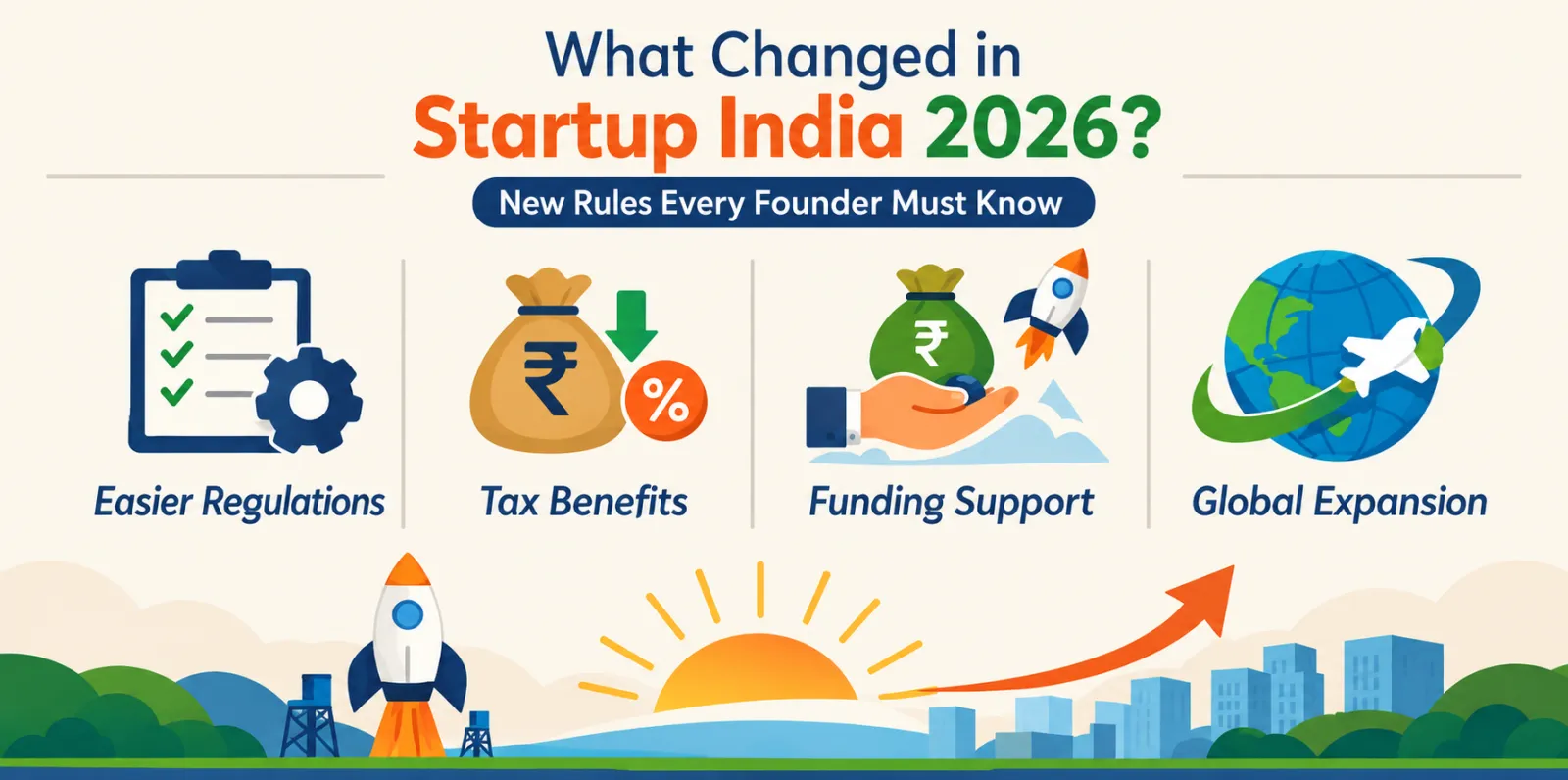
Learn about Startup India Registration, the revised 2026 DPIIT eligibility criteria, National Startup Awards 6.0, required documents, application steps and benefits for eligible startups.
Startup India Registration: 2026 Eligibility & Latest Updates
Introduction
Startup India Registration helps eligible businesses apply for recognition from the Department for Promotion of Industry and Internal Trade (DPIIT) under the Government of India's Startup India initiative. This recognition can help qualifying startups access certain government support programmes, intellectual property support and other benefits, subject to the applicable rules and separate eligibility conditions.
In 2026, important developments have made startup recognition especially relevant for founders. The government revised the DPIIT recognition framework in February, increasing the general turnover threshold to ₹200 crore and introducing a separate category for Deep Tech Startups. On 27 October 2026, DPIIT also launched the sixth edition of the National Startup Awards, with applications open until 20 November 2026. These updates make it important for founders to understand the current eligibility criteria, prepare the right documents and apply through the official government process.
Latest Startup India Registration News in 2026
Two recent government updates are particularly important for businesses exploring Startup India Registration.
1. Revised DPIIT startup recognition framework
On 5 February 2026, the Ministry of Commerce and Industry announced revisions to the startup recognition framework. The general turnover threshold was increased from ₹100 crore to ₹200 crore. The revised framework also introduced a dedicated Deep Tech Startup category, recognising the longer research and development cycles often associated with advanced technologies.
Under the revised framework, eligible Deep Tech Startups can have an age limit of up to 20 years from incorporation or registration and a turnover threshold of ₹300 crore, subject to the category's prescribed conditions.
These changes may allow more businesses to qualify for recognition, but founders must still satisfy the applicable entity, innovation and other requirements. Read the official government announcement on revised startup recognition criteria.
2. National Startup Awards 6.0 launched
On 27 October 2026, DPIIT launched the sixth edition of the National Startup Awards under the Startup India initiative. Applications are open from 27 October to 20 November 2026.
The awards cover 20 sectoral categories and three special award categories, including Women-Led Startup of the Year, North-East Startup Excellence and Student Innovator / Aspiring Entrepreneur. Eligible startups can receive recognition and, where applicable, awards and opportunities for mentorship, investor engagement and market access. The official guidelines determine who can apply and the conditions for each category.
National Startup Awards participation is separate from applying for DPIIT recognition. A founder should not assume that receiving recognition automatically guarantees an award or funding.
Check the official National Startup Awards 6.0 page for the application conditions and category details.
What Is Startup India Registration and Why Is It Important?
Startup India Registration commonly refers to obtaining DPIIT Startup Recognition for an eligible business. It is different from incorporating a company or registering a business entity. A founder must first establish an eligible business structure and then apply for recognition through the prescribed government process.
DPIIT recognition can be useful because it may help an eligible startup access specific government programmes, intellectual property facilitation and other benefits, depending on the scheme's conditions.
Potential advantages include:
-
Access to eligible government schemes: Recognition may be a prerequisite for certain startup programmes.
-
Intellectual property support: Eligible startups may benefit from facilitation under applicable intellectual property support arrangements.
-
Tax-related opportunities: Eligible businesses may apply for specific tax benefits separately if they meet the relevant legal conditions.
-
Easier discovery within the startup ecosystem: Recognition can help establish the business's status when interacting with certain programmes and ecosystem stakeholders.
-
Access to eligible awards and support initiatives: DPIIT recognition is a requirement for some startup-specific opportunities, subject to their individual rules.
Recognition does not mean that every benefit is automatically available. For example, tax relief under Section 80-IAC requires a separate application and approval under the applicable conditions. Funding schemes also have their own eligibility and selection processes.
For help understanding the process, explore CertifyKaro's Startup India Recognition service.
What Are the Eligibility Criteria for Startup India Registration in 2026?
Before applying, check whether your business meets the current DPIIT requirements. The general criteria and Deep Tech criteria are not identical, so founders should review the official notification relevant to their business.
1. Eligible business structure
The business must generally be incorporated as a Private Limited Company, registered Partnership Firm or Limited Liability Partnership (LLP). A sole proprietorship alone does not meet the standard entity-structure requirement for DPIIT Startup Recognition.
2. Age of the business
Under the general startup framework, an entity is generally considered a startup for up to 10 years from its incorporation or registration, subject to the applicable conditions. The revised framework provides a longer period of up to 20 years for eligible Deep Tech Startups.
3. Turnover limit
The revised general turnover threshold is ₹200 crore. For eligible Deep Tech Startups, the threshold is ₹300 crore, subject to the relevant category requirements.
Founders should verify the precise definition of turnover, the relevant financial years and any other conditions in the current official notification.
4. Innovation or improvement
The business should work towards innovation, development or improvement of products, processes or services, or have a scalable business model with potential for employment generation or wealth creation, as required under the applicable rules.
5. Not formed by splitting up an existing business
A business formed by splitting up or reconstructing an existing business may not qualify under the standard startup recognition framework, subject to the applicable legal provisions.
Because the criteria were revised in 2026, avoid relying on older articles that still list the previous ₹100 crore general turnover threshold. Always verify the latest information on the official Startup India portal.
How to Apply for Startup India Registration Online
Once your business is incorporated and you have checked the criteria, follow these practical steps.
Step 1: Establish the business entity
Register your business under an eligible legal structure. Keep your incorporation or registration certificate and relevant business details available.
Step 2: Check the latest DPIIT criteria
Review the current eligibility conditions, including the revised turnover thresholds, business age and innovation requirements. If your business operates in Deep Tech, check the separate category conditions.
Step 3: Prepare the required documents
Depending on the application and entity structure, you may need:
-
Certificate of Incorporation or Registration.
-
PAN and entity details.
-
Details of directors, partners or authorised representatives.
-
A description of the business and its innovative or scalable features.
-
Website, pitch deck or product information, where relevant.
-
Information supporting the business's activities and model.
-
Any additional documents requested in the current application form.
This is a general checklist. Follow the current official application instructions to confirm exactly what is required for your business.
Step 4: Create or access your account
Visit the official Startup India portal. Follow the current instructions to create an account or log in.
Step 5: Apply through the prescribed government system
The official Startup India guidance directs applicants to the National Single Window System (NSWS) for the recognition application. Log in to NSWS, open Add Approvals, select Central Approvals, find the startup recognition application and add it to your dashboard.
Complete the required fields, upload the supporting information and submit the application through the official process.
Step 6: Review the application carefully
Check the business name, registration details, authorised representative information and description of innovation before submission. Incorrect or inconsistent information can lead to queries or delays.
Step 7: Track the application and certificate
Monitor the official portal for status updates or requests for clarification. If your startup is recognised, follow the official instructions to access or download the recognition certificate.
The government states that DPIIT Startup Recognition is available without a government application fee. Be cautious of anyone claiming to be an officially appointed agent who can guarantee recognition. You may separately choose to pay a professional adviser for assistance with preparation or review.
What Benefits Can a DPIIT-Recognised Startup Receive?
The benefits available to a recognised startup depend on the programme and the business's eligibility.
Government schemes and funding support
Some government schemes support eligible startups through incubators, investment mechanisms, credit guarantees or other programme-specific arrangements. DPIIT recognition alone does not guarantee funding. Each scheme has its own eligibility criteria, application process and selection method.
Tax benefits
Eligible startups may explore the tax deduction under Section 80-IAC, where the relevant legal requirements are met. Recognition and tax eligibility are separate matters, and approval for the tax benefit is not automatic.
Read more about CertifyKaro's Section 80-IAC service.
Intellectual property support
Eligible startups may be able to access facilitation and support under applicable intellectual property programmes. The exact benefits and fees depend on the relevant scheme and type of intellectual property application.
Awards and market access
National Startup Awards and other programmes can provide opportunities for eligible startups to showcase their solutions, subject to the rules of each initiative. The 2026 awards edition has separate categories and application conditions.
Founders should always read the latest official scheme guidelines before making financial or business decisions.
Common Mistakes to Avoid During Startup India Registration
Avoid these common errors to improve the quality of your application:
-
Using outdated eligibility information: Check the revised 2026 criteria rather than relying on old turnover limits.
-
Applying before establishing an eligible entity: Confirm that your business structure meets the requirements.
-
Providing a vague innovation description: Explain the product, service, process or business model clearly and accurately.
-
Submitting inconsistent information: Match the application with official entity records.
-
Assuming recognition guarantees funding: Review each funding programme separately.
-
Assuming tax benefits are automatic: Check the separate legal requirements for tax approval.
-
Using unofficial portals or sharing login credentials: Apply through the official government system and protect your account details.
-
Ignoring application updates: Monitor the dashboard for requests or status changes.
Frequently Asked Questions About Startup India Registration
1. How can I apply for Startup India Registration online?
Check the eligibility criteria, prepare your entity and business details, then follow the official Startup India guidance to submit the recognition application through NSWS. Track the application for updates or requests for information.
2. What is the turnover limit for Startup India Registration in 2026?
The revised general startup recognition turnover threshold is ₹200 crore. Eligible Deep Tech Startups have a separate threshold of ₹300 crore, subject to the applicable conditions.
3. Is there any government fee for DPIIT Startup Recognition?
The government states that the DPIIT Certificate of Recognition application is free. A business may separately choose to pay a professional adviser for assistance, but that is not a government application fee.
4. Does Startup India Registration provide tax benefits automatically?
No. DPIIT recognition does not automatically grant every tax benefit. Specific benefits, such as Section 80-IAC, have separate eligibility requirements and approval processes.
5. Can a recognised startup apply for National Startup Awards 6.0?
DPIIT-recognised startups may apply under the eligible award categories, subject to the official guidelines. Applications for National Startup Awards 6.0 are open from 27 October to 20 November 2026. Check the official award page for category-specific conditions.
Conclusion
Startup India Registration can help an eligible business access opportunities under the government's startup ecosystem. The revised 2026 DPIIT framework has updated the general turnover threshold and introduced a separate Deep Tech Startup category. The launch of National Startup Awards 6.0 also provides an opportunity for eligible startups to seek recognition for their innovation and impact.
Before applying, verify your business structure, age, turnover and innovation criteria. Prepare accurate documents, use the official government portal and review separate scheme requirements before relying on any tax, funding or other benefit.
Need help with Startup India Registration?
CertifyKaro se contact karo.
Call: +91 70422 52542
Service page: /services/startup-india
Disclaimer: This article is for general informational purposes only and does not constitute legal, tax or financial advice. Eligibility, benefits and application procedures depend on the current official rules. Verify the latest conditions through Startup India, DPIIT and the relevant scheme authorities.