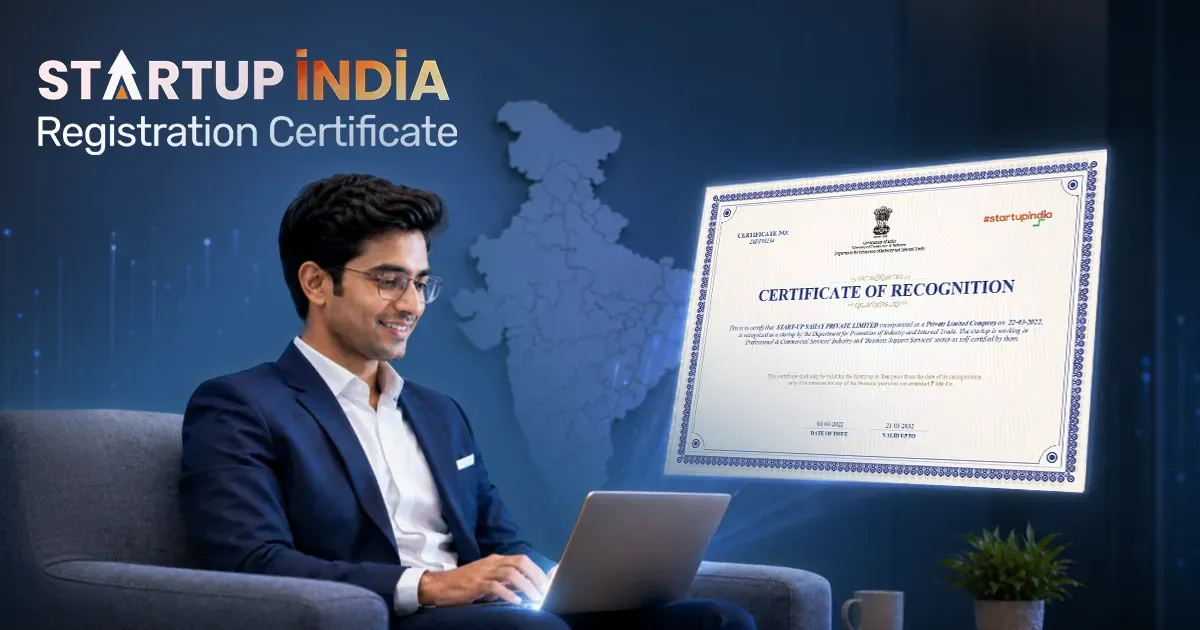
Meta Description: Startup India Registration 2026 brings updated DPIIT eligibility, ₹200 crore turnover limit and DeepTech rules. Check process, benefits and documents with CertifyKaro.
Introduction
If you are planning to register your business under Startup India, 2026 has brought an important change that can affect your eligibility. The Department for Promotion of Industry and Internal Trade (DPIIT) has revised the turnover threshold for startup recognition from ₹100 crore to ₹200 crore, while eligible DeepTech startups can have a turnover threshold of up to ₹300 crore. The updated framework also provides a longer recognition period for DeepTech businesses.
This makes Startup India Registration 2026 particularly relevant for growing businesses that may previously have been close to the old turnover limit. However, turnover is only one part of the eligibility test. Your entity type, age, innovation or scalability, business structure and supporting documents also matter.
This guide explains the latest DPIIT rules, who can apply, how the registration process works, what benefits recognition can provide and how to avoid common application problems.
Latest DPIIT Update for Startup India Registration
The most important recent change comes from DPIIT Gazette Notification G.S.R. 108(E), dated 4 February 2026. The notification superseded the earlier 2019 framework and revised the definition and eligibility criteria for startups.
For a normal startup, the current framework provides:
- The entity should generally be incorporated or registered in India as a Private Limited Company, registered Partnership Firm, LLP, Multi-State Cooperative Society or eligible Cooperative Society.
- The entity should generally be within 10 years from incorporation or registration.
- Turnover should not exceed ₹200 crore in any financial year since incorporation or registration.
- The business should work towards innovation, development or improvement of products, processes or services, or have a scalable business model with potential for employment generation or wealth creation.
- The entity should not have been formed by splitting up or reconstructing an existing business.
For recognised DeepTech startups, the framework provides up to 20 years from incorporation or registration and a turnover threshold of up to ₹300 crore, subject to the applicable DeepTech conditions.
The Startup India portal has also specifically advised existing DPIIT-recognised startups to log in with their registered credentials and download their updated Startup Recognition certificate following the change.
The practical point for founders is simple: do not rely on older Startup India eligibility information showing a ₹100 crore turnover limit. Check the current 2026 criteria before applying or assessing your existing recognition.
What Is Startup India Registration and Who Can Apply?
Startup India Registration commonly refers to obtaining DPIIT Startup Recognition under the Startup India initiative. It is important to understand that incorporating a company and obtaining DPIIT recognition are two different steps.
First, you need an eligible legal entity. After that, the eligible entity can apply for DPIIT recognition through the designated online system.
The current Startup India framework recognises eligible:
- Private Limited Companies
- Limited Liability Partnerships
- Registered Partnership Firms
- Eligible Cooperative Societies
The business should also satisfy the applicable age, turnover and innovation/scalability conditions.
For example, simply opening a normal trading or service business does not automatically mean that the business qualifies as a DPIIT-recognised startup. The application needs to explain the product, service, process or business model and demonstrate how it meets the applicable criteria.
The application is based on self-certification, but supporting information and documents may be required. DPIIT can revoke recognition if it is subsequently found that recognition was obtained using false information or without the required supporting documents.
This is why founders should prepare their business description carefully instead of treating Startup India Registration Online as just a basic form-filling exercise.
What Are the Benefits of DPIIT Startup Recognition?
Many founders search for Startup India benefits because DPIIT recognition can provide access to several government-supported benefits and relaxations. However, recognition itself does not mean that every benefit automatically becomes available.
Depending on the applicable conditions, recognised startups can access areas such as:
- Self-certification under specified labour and environmental laws
- Intellectual property support and faster patent processing
- Certain public procurement relaxations
- Startup-focused funding and support programmes
- Government startup programmes and challenges
- Easier winding-up provisions subject to applicable law
- Eligibility to apply for certain tax-related benefits
For example, Startup India states that recognised startups can benefit from public procurement relaxations, including relief from certain prior experience, prior turnover and Earnest Money Deposit requirements in applicable government procurement processes.
Similarly, recognised startups may apply separately for Section 80-IAC tax exemption, subject to the specific eligibility requirements and approval process. DPIIT recognition by itself should not be described as an automatic three-year income-tax exemption.
This distinction is important because many founders assume that receiving the DPIIT certificate automatically activates every Startup India benefit. In reality, several benefits have separate eligibility criteria, applications or approvals.
How to Apply for Startup India Registration Online?
The online process has become easier, but incorrect information can still create unnecessary delays or questions.
The current Startup India recognition process is available through the National Single Window System (NSWS). Startup India states that applicants can create an account on NSWS, add the “Registration as a Startup” approval and submit the application.
Step-by-Step Startup India Registration Process
1. Check your eligibility
Before starting the application, check:
- Entity type
- Incorporation/registration date
- Turnover
- Business activity
- Innovation or scalability
- Existing business structure
- DeepTech eligibility, if applicable
2. Keep your incorporation documents ready
Your incorporation or registration certificate is an important part of the application.
3. Prepare your business description
Clearly explain:
- What problem your business solves
- Your product or service
- What is innovative or different
- How the business can scale
- How it can generate employment or wealth
Avoid generic descriptions copied from websites. The explanation should accurately represent your actual business.
4. Create/login to your NSWS account
Go to the National Single Window System and add the Registration as a Startup approval.
5. Complete the DPIIT recognition application
Enter the entity, founder and business details carefully. Some information may be linked or auto-filled based on the profile.
6. Upload supporting information
Depending on your application, supporting documents such as incorporation documents, authorisation letter and business evidence may be required. Startup India also provides fields for supporting material such as websites, videos, pitch decks or patents where relevant.
7. Review before submission
Check the legal name, incorporation details, PAN, business description and uploaded documents before submitting.
8. Track and download your certificate
After recognition, maintain the certificate safely. Existing recognised startups should also check the Startup India portal for the updated certificate following the 2026 turnover revision.
Common Problems in Startup India Registration
Many applications face problems not because the business is necessarily ineligible, but because the application does not clearly demonstrate eligibility.
Problem 1: Using old eligibility limits
Older articles may still mention the ₹100 crore turnover threshold. For 2026, the revised framework uses ₹200 crore for normal startups and up to ₹300 crore for recognised DeepTech startups, subject to the applicable conditions.
Problem 2: Weak innovation explanation
Writing “our company is innovative” is usually not enough. Explain what is actually different about the product, process, technology or scalable model.
Problem 3: Wrong entity assumption
A founder may assume that having a business registration automatically makes the entity eligible for DPIIT recognition. Entity type and other conditions must be checked against the current notification.
Problem 4: Confusing DPIIT recognition with tax exemption
DPIIT recognition and Section 80-IAC tax exemption are separate processes. A recognised startup may need to make a separate application and satisfy additional conditions.
Problem 5: Incorrect information
Since the application involves self-certification, founders should ensure that the information submitted is accurate and supported by relevant documents. DPIIT states that recognition can be revoked where false information or missing relevant documents are subsequently identified.
Startup India Registration Checklist for Founders
Before submitting your application, keep this checklist ready:
- Confirm your entity structure.
- Check the incorporation/registration date.
- Check your turnover against the current 2026 threshold.
- Determine whether the DeepTech category may apply.
- Keep the incorporation/registration certificate ready.
- Keep PAN and entity details accurate.
- Prepare a clear business description.
- Explain your innovation, development or scalability.
- Keep website, pitch deck, product material or other supporting evidence ready where relevant.
- Check that the authorisation details are correct.
- Review every self-certification before submission.
- Save your application and recognition records.
- If already recognised, log in and download the updated certificate.
- Separately check eligibility for tax and other Startup India benefits.
FAQ: Startup India Registration 2026
1. What is the new turnover limit for Startup India Registration in 2026?
Under the 2026 DPIIT framework, the turnover threshold for a normal startup is ₹200 crore in any financial year since incorporation or registration. Eligible DeepTech startups can have a threshold of ₹300 crore, subject to the applicable DeepTech criteria.
2. Can an LLP apply for DPIIT Startup Recognition?
Yes. An eligible Limited Liability Partnership can apply for DPIIT Startup Recognition if it satisfies the applicable age, turnover and innovation/scalability requirements.
3. Is Startup India Registration the same as company registration?
No. Company or LLP registration creates the legal entity. DPIIT Startup Recognition is a separate recognition under the Startup India initiative for eligible entities.
4. Does DPIIT recognition automatically provide 80-IAC tax exemption?
No. DPIIT recognition and Section 80-IAC tax exemption are separate. A recognised startup must satisfy the additional conditions and complete the applicable tax-exemption process.
5. Where can I apply for DPIIT Startup Recognition?
The current Startup India process directs eligible entities to the National Single Window System (NSWS), where the “Registration as a Startup” approval can be added and submitted online.
SEO Keywords
Startup India Registration, Startup India Registration 2026, DPIIT Startup Registration, DPIIT Recognition, Startup India Registration Online, DPIIT Certificate, Startup India Certificate, Startup Recognition Certificate, Startup India Benefits, Startup India Eligibility, DPIIT Startup Recognition, Startup India Scheme, Startup Registration in India, DeepTech Startup Recognition, Startup India Tax Benefits.
CTA
Planning to apply for Startup India Registration or need help checking your DPIIT eligibility?
CertifyKaro se contact karo for assistance with Startup India/DPIIT recognition, documentation and the application process.
Call: +91 70422 52542