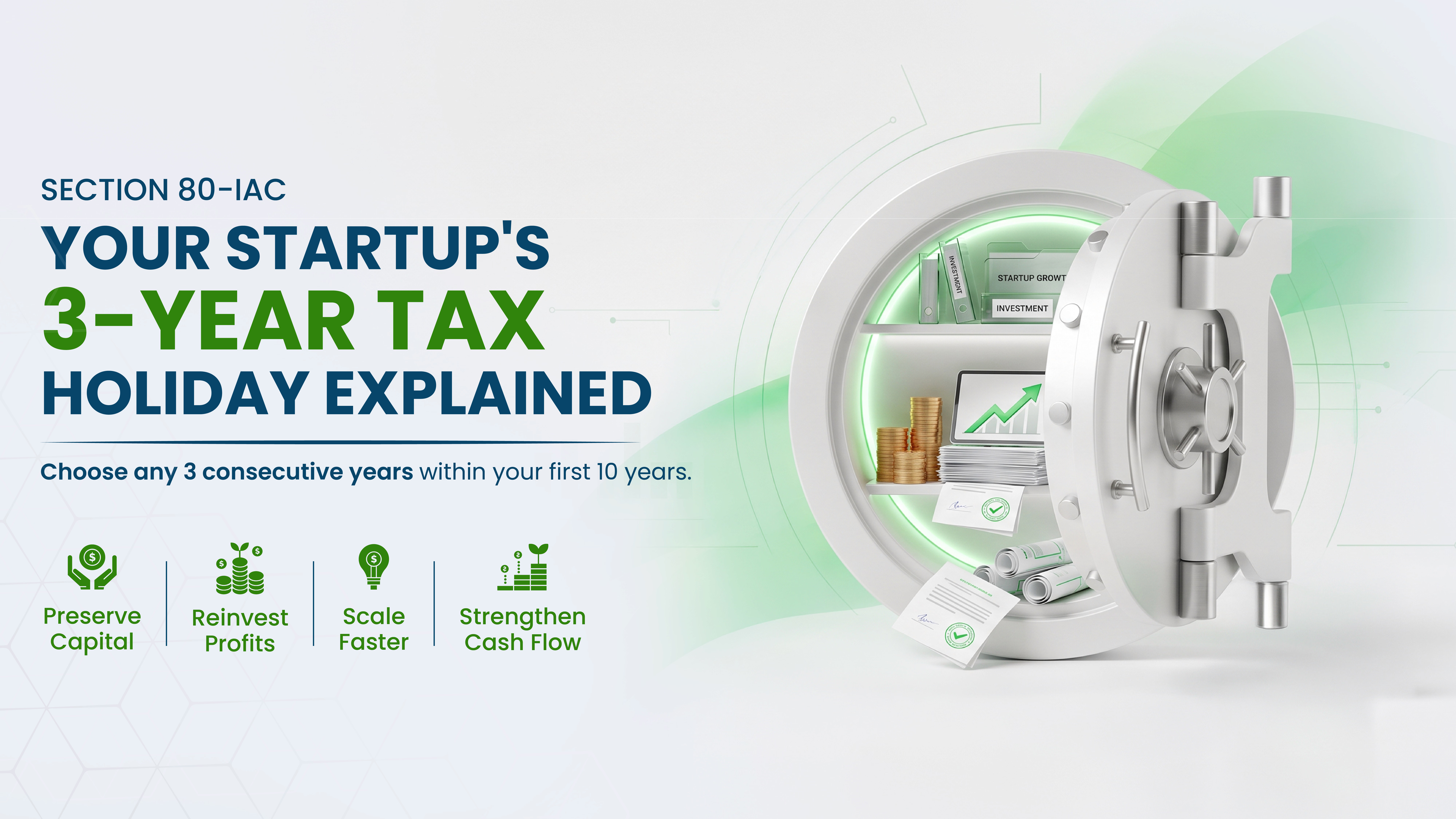
Section 80-IAC Certification 2026 offers eligible startups a 100% profit deduction for 3 years. Check eligibility, documents, process and tax rules with CertifyKaro.
Introduction
For eligible startups, Section 80-IAC Certification can be one of the most valuable tax benefits available under the Startup India framework. The benefit allows an eligible startup to claim a 100% deduction on qualifying business profits for three consecutive assessment years, selected within the first ten years from incorporation.
There is also an important recent development. The government extended the incorporation deadline for startups seeking the Section 80-IAC benefit from 1 April 2025 to 1 April 2030. This means eligible startups incorporated before 1 April 2030 can potentially apply, subject to all other conditions.
At the same time, many founders make one major mistake: they assume that getting a DPIIT Startup Recognition Certificate automatically gives them the 80-IAC tax benefit. It does not. A separate eligibility process and certificate from the Inter-Ministerial Board are required.
This guide explains the latest 2026 rules, eligibility, documents, application process and common reasons why applications face problems.
Latest Section 80-IAC Tax Exemption Update in 2026
The major recent policy change for Section 80-IAC came through the Union Budget 2025 and the subsequent amendment extending the incorporation window.
Earlier, the tax benefit was available to qualifying startups incorporated before 1 April 2025. The amendment extended this date to before 1 April 2030. The Income Tax Department's current guidance confirms that eligible startups incorporated from 1 April 2016 but before 1 April 2030 can qualify, subject to the remaining conditions.
The core tax benefit remains significant: an eligible startup can claim up to 100% deduction of profits and gains for three consecutive assessment years out of the ten-year period beginning from incorporation.
However, founders should not confuse this with the newer DPIIT startup-recognition framework. DPIIT recognition has broader eligibility categories, while Section 80-IAC has its own tax-law definition of an eligible startup.
For example, the current Income Tax Department guidance says that, for Section 80-IAC, the startup must be a company or LLP, must satisfy the specified incorporation period and must have turnover not exceeding ₹100 crore in the relevant previous year. It must also hold the required certificate of eligible business.
Therefore, a startup may qualify for DPIIT recognition under the current Startup India framework but still fail to qualify for the 80-IAC deduction.
What Is Section 80-IAC Certification and How Does It Work?
Section 80-IAC provides a profit-linked tax deduction to qualifying startups. The benefit is not simply a registration certificate or general Startup India concession.
The basic structure works like this:
- First, the business should qualify for DPIIT Startup Recognition.
- The eligible entity then applies for the Section 80-IAC benefit.
- The application is evaluated under the applicable framework.
- The Inter-Ministerial Board of Certification grants the Certificate of Eligibility where the startup satisfies the required conditions.
- After receiving the necessary approval, the startup can claim the eligible deduction for three consecutive assessment years within the permitted ten-year period.
The important point is that the benefit is a deduction of eligible business profits, not a cash grant.
For example, if an eligible startup has qualifying business profits of ₹20 lakh in a particular assessment year and validly chooses that year as one of its three deduction years, the eligible deduction can be up to ₹20 lakh, subject to the applicable provisions and computation rules.
The startup therefore needs proper accounting records and tax compliance. The benefit should not be treated as “zero tax automatically for three years” without checking the actual taxable income, eligible business and applicable tax provisions.
The Income Tax Department specifically explains that DPIIT recognition and Section 80-IAC eligibility are not identical concepts. This distinction is extremely important when planning the application.
Who Is Eligible for Section 80-IAC Tax Exemption?
One of the most common questions founders ask is whether every DPIIT-recognised startup can claim Section 80-IAC.
The answer is no.
The current tax guidance requires several conditions to be satisfied. Broadly, an eligible startup should meet the following requirements:
- It should be a qualifying company or Limited Liability Partnership.
- It should have been incorporated or registered within the specified statutory period.
- For the current Section 80-IAC framework, the incorporation must be on or after 1 April 2016 and before 1 April 2030.
- Turnover should not exceed the statutory limit applicable for the relevant previous year.
- The startup should hold the required certificate of eligible business from the Inter-Ministerial Board of Certification.
- The business should be engaged in innovation, development or improvement of products, processes or services, or operate a scalable business model with significant potential for employment generation or wealth creation.
- The startup should be recognised by DPIIT.
- It should not have been formed by splitting up or reconstructing an existing business, subject to specific statutory exceptions.
- The business should satisfy the applicable conditions relating to assets and previously used plant or machinery.
The ₹100 crore turnover condition deserves special attention. The 2026 DPIIT startup-recognition framework has introduced broader turnover limits for recognition, but that does not automatically change the separate turnover test under Section 80-IAC.
Therefore, founders should check the tax-law eligibility separately before assuming that their DPIIT certificate makes them eligible for the deduction.
How Many Years Can a Startup Claim the 80-IAC Benefit?
The tax benefit is available for three consecutive assessment years out of the first ten assessment years beginning from the year of incorporation, subject to the statutory requirements.
This gives founders an important planning opportunity.
A startup does not necessarily need to claim the deduction immediately in its first profitable year. The choice of the three consecutive years should be planned according to the startup's actual business and tax position, while staying within the statutory window.
For example:
- Startup incorporated in 2022.
- It receives the required Section 80-IAC eligibility approval.
- It becomes profitable in a later year.
- It may choose an appropriate three-year consecutive period within the permitted window, subject to the law.
- The eligible deduction is claimed for those assessment years according to the applicable tax provisions.
This is why founders should discuss the timing with their tax professional instead of simply selecting the first available year without considering future profitability.
What Documents Are Required for Section 80-IAC Certification?
A strong application should clearly demonstrate both legal eligibility and the substance of the business.
The 2026 government application framework specifically asks for information and supporting evidence relating to the startup's innovation, wealth creation and employment generation.
Commonly relevant documents and information include:
- Certificate of Incorporation or registration
- PAN of the startup
- Memorandum of Association or LLP Agreement, as applicable
- Board Resolution or authorised signatory details
- Shareholding details
- Financial statements
- Audited accounts where applicable
- Profit and Loss Account
- Balance Sheet
- Business plan or detailed business description
- Product or service information
- Details explaining innovation or technological development
- IPR or patent information, where applicable
- Revenue or user-growth information
- Employment data
- Funding information, where relevant
- Awards, recognitions or market evidence, where applicable
- Documents supporting scalability and economic impact
The important point is not to upload documents simply to complete a checklist. The documents should tell a consistent story about the business.
For example, if the application claims technological innovation but the business description only explains routine trading activities, the application may not clearly demonstrate eligibility.
How to Apply for Section 80-IAC Certification?
The application should be approached as a compliance and tax-benefit application rather than a simple form submission.
Step 1: Verify DPIIT Recognition
Check whether the startup already has valid DPIIT recognition.
If not, the startup may first need to complete the Startup India/DPIIT recognition process.
Step 2: Check Separate 80-IAC Eligibility
Do not rely only on DPIIT recognition. Verify:
- Entity type
- Incorporation date
- Turnover
- Nature of business
- Innovation
- Scalability
- Employment potential
- Existing business history
Step 3: Prepare Financial Records
Keep the relevant financial statements and accounting information ready. Incomplete or inconsistent financial information can create questions during evaluation.
Step 4: Prepare an Innovation Case
Clearly explain:
- What problem the startup solves
- What makes its product or service different
- What technology or process is used
- How the business can scale
- How it can create employment or wealth
- What evidence supports these claims
Step 5: Prepare Supporting Documents
Organise incorporation documents, financial statements, business evidence, IPR details and other relevant supporting material.
Step 6: Submit the 80-IAC Application
Complete the applicable Section 80-IAC application and provide accurate information.
Step 7: Respond to Queries Carefully
If clarification or additional information is requested, respond with specific evidence instead of generic statements.
Step 8: Obtain the Eligibility Certificate
Once the application is approved, retain the Certificate of Eligibility and related records for tax and compliance purposes.
Common Reasons Section 80-IAC Applications Face Problems
1. Confusing DPIIT Recognition with 80-IAC Approval
This is probably the most important mistake. DPIIT recognition is not the same as the 80-IAC eligibility certificate.
2. Weak Innovation Explanation
Simply calling a business “innovative” is not enough. The application should explain the actual innovation, product improvement, technology, process or scalable model.
3. Turnover Eligibility Not Checked
A startup may satisfy the broader DPIIT recognition threshold but still need to satisfy the separate Section 80-IAC turnover condition.
4. Incomplete Financial Information
Financial statements and revenue information should be consistent with the information provided in the application.
5. Generic Business Plan
A copied business description does not effectively demonstrate why the particular startup deserves recognition for the tax benefit.
6. Applying Without Tax Planning
The three-year deduction should be considered along with profitability, accounting and other tax provisions. Proper timing can be important.
Section 80-IAC Certification Checklist
Before submitting the application, founders should check:
- DPIIT recognition is available.
- Entity type is eligible.
- Incorporation date falls within the permitted period.
- Turnover satisfies the Section 80-IAC requirement.
- Business meets the innovation/scalability criteria.
- Startup is not formed by splitting or reconstructing an existing business.
- Financial statements are ready.
- Shareholding details are updated.
- Business plan clearly explains innovation.
- Product/service evidence is available.
- Employment and scalability evidence is prepared.
- IPR/patent information is included where relevant.
- All declarations are accurate.
- Tax planning has been discussed before selecting the deduction years.
Section 80-IAC vs DPIIT Startup Recognition
These two registrations are often confused.
Point | DPIIT Startup Recognition | Section 80-IAC |
Main purpose | Startup recognition and access to benefits | Profit-linked tax deduction |
Entity coverage | Broader eligible entity categories | Company/LLP under tax law |
Tax deduction | Not automatically provided | Up to 100% eligible profit deduction |
Approval | DPIIT recognition | Separate eligibility certification |
Profit benefit | No automatic 3-year deduction | 3 consecutive assessment years |
Key requirement | Current DPIIT eligibility | Separate 80-IAC conditions |
Therefore, founders should think of Section 80-IAC as a separate tax-benefit stage after startup recognition, rather than another name for DPIIT registration.
FAQ: Section 80-IAC Certification 2026
1. What is Section 80-IAC Certification?
Section 80-IAC Certification is the eligibility approval required for a qualifying startup to claim the Section 80-IAC profit deduction, subject to the applicable Income Tax law and conditions.
2. How much tax exemption is available under Section 80-IAC?
An eligible startup can claim a deduction of up to 100% of eligible business profits for three consecutive assessment years out of the permitted ten-year period, subject to all statutory conditions.
3. Is DPIIT recognition enough for 80-IAC tax exemption?
No. DPIIT recognition is a prerequisite, but it does not automatically grant the Section 80-IAC deduction. A separate eligibility process and certificate are required.
4. What is the 2026 incorporation deadline for Section 80-IAC?
The eligibility window has been extended so that qualifying startups incorporated before 1 April 2030 can potentially apply, subject to all other Section 80-IAC conditions.
5. Can an LLP claim Section 80-IAC tax exemption?
Yes. An eligible LLP can qualify, provided it satisfies the requirements under Section 80-IAC, including the applicable incorporation, turnover, business and certification conditions.
SEO Keywords
Section 80-IAC Certification, Section 80-IAC Tax Exemption, 80-IAC Certification 2026, Section 80-IAC Eligibility, 80-IAC Startup Tax Exemption, Startup Tax Exemption India, 80-IAC Application, 80-IAC Certificate, Startup India Tax Benefits, DPIIT Tax Exemption, 80-IAC Registration, Section 80-IAC Documents, Startup Income Tax Exemption, Inter-Ministerial Board Certification, Startup Tax Holiday India.
CTA
Planning to apply for Section 80-IAC Certification or confused about whether your startup qualifies?
CertifyKaro se contact karo for assistance with DPIIT recognition, Section 80-IAC eligibility, documentation and the application process.
Call: +91 70422 52542