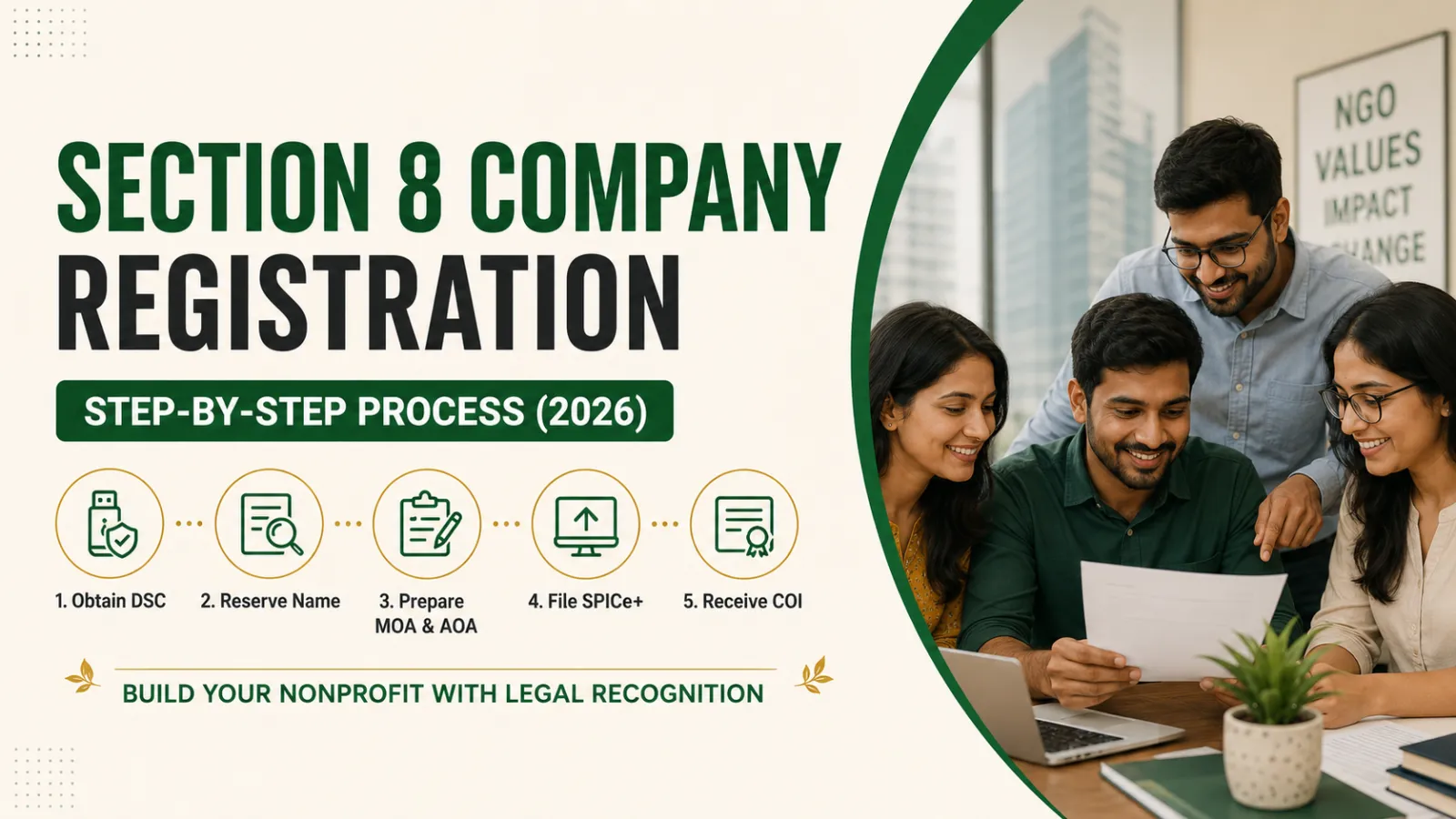
A practical 2026 guide to Section 8 Company Registration in India, including the latest CSR funding amendment, eligibility, documents, registration steps and compliance requirements.
Section 8 Company Registration: 2026 CSR Rule Update
Introduction
Section 8 Company Registration is an important option for individuals and organisations that want to establish a non-profit company in India. It is suitable for activities such as education, healthcare, social welfare, environmental protection, research, charity and community development. Under Section 8 of the Companies Act, 2013, eligible organisations must apply their profits and income towards their objectives and cannot distribute dividends to their members.
In 2026, an important development for the non-profit sector came from the Ministry of Corporate Affairs (MCA). The government amended the Corporate Social Responsibility (CSR) framework to recognise eligible Zero Coupon Zero Principal (ZCZP) instruments listed on the Social Stock Exchange as a permitted route for CSR spending. This development may create new fundraising opportunities for eligible not-for-profit organisations.
However, registering a Section 8 company does not automatically provide tax exemptions, government grants or CSR funding. Founders must understand the registration procedure, eligibility requirements, documentation and ongoing compliance before establishing their organisation.
What Is Section 8 Company Registration in India?
Section 8 Company Registration is the process of incorporating an eligible non-profit company under the Companies Act, 2013. Its objectives must promote activities such as education, science, research, social welfare, charity, environmental protection, sports or other qualifying purposes.
A Section 8 company operates as a separate legal entity. It can receive eligible donations, grants and income from permitted activities, subject to applicable laws. However, its profits must be used to promote its approved objectives rather than distributed among members as dividends.
Who should consider registering a Section 8 company?
This structure may suit:
-
Entrepreneurs planning a social-impact initiative.
-
Individuals establishing educational or charitable institutions.
-
Organisations supporting healthcare or environmental protection.
-
Groups working in skill development and community welfare.
-
Founders seeking a formal corporate structure for eligible non-profit activities.
What are the main benefits?
Separate legal identity: The company has its own legal identity, separate from its members.
Institutional credibility: Formal incorporation can support trust among donors, beneficiaries, institutions and potential partners.
Structured governance: Directors and members operate within a defined legal framework.
Fundraising opportunities: Depending on eligibility, an organisation may access permitted donations, grants and other funding routes.
Long-term sustainability: Proper accounting, governance and documentation can help an organisation manage its activities transparently.
The correct structure depends on your objectives and funding plans. If you are considering a commercial business instead, compare the requirements for Private Limited Company Registration before deciding.
What Is the Latest 2026 CSR Rule Update for Section 8 Companies?
The Ministry of Corporate Affairs notified the Companies (Corporate Social Responsibility Policy) Amendment Rules, 2026, through notification G.S.R. 415(E), dated 27 May 2026. A related notification, G.S.R. 416(E), amended Schedule VII of the Companies Act, 2013.
The changes recognise subscription to eligible Zero Coupon Zero Principal instruments on the Social Stock Exchange as a permissible CSR activity. The framework is intended to help eligible not-for-profit organisations raise funds for public-welfare projects through a regulated mechanism.
What is a Zero Coupon Zero Principal instrument?
A Zero Coupon Zero Principal instrument is a security issued by an eligible not-for-profit organisation registered with the Social Stock Exchange segment of a recognised stock exchange, in accordance with applicable SEBI regulations.
Unlike a conventional investment, it does not provide interest or repayment of principal in the usual manner. It is designed to channel funds towards specified social-impact projects.
Key points organisations must understand
-
10% CSR expenditure limit: Spending through these instruments cannot exceed 10% of the subscribing company's total CSR expenditure for that financial year.
-
Eligibility requirements: The issuing organisation must satisfy the applicable Social Stock Exchange and SEBI requirements.
-
Project accountability: Funds must be used for the specified purpose and handled according to applicable rules.
-
Compliance obligations: Organisations must follow the relevant project, reporting and fund-utilisation requirements.
-
No automatic qualification: A Section 8 company is not automatically eligible to issue these instruments merely because it has been incorporated.
This update is particularly relevant to organisations working in education, healthcare, skill development, environmental protection and other eligible public-welfare areas.
For the official announcement, read the MCA update published by the Press Information Bureau. Founders should review the complete notifications and applicable SEBI requirements before planning fundraising.
What Are the Eligibility Criteria for Section 8 Company Registration?
Before applying, founders should ensure that their proposed organisation meets the Companies Act, 2013, and applicable incorporation rules.
The principal requirements include:
-
Permitted objectives: The organisation must pursue eligible charitable, social or other qualifying objectives.
-
Application of income: Its profits and other income must be applied towards promoting those objectives.
-
Restriction on dividends: It must not distribute dividends to its members.
-
Minimum members and directors: A private company generally requires at least two members and two directors. A public company generally requires at least seven members and three directors, subject to applicable law.
-
Registered office: The company must provide a valid registered office address and supporting documentation.
-
Constitutional documents: Its Memorandum of Association (MOA) and Articles of Association (AOA) must reflect its objectives and the applicable restrictions.
-
Regulatory approval: The application must follow the MCA's prescribed incorporation procedure.
A proposed name should comply with applicable naming rules and accurately represent the organisation's purpose. The required documents and forms can vary depending on the proposed structure and the applicants' circumstances.
Which Documents Are Required for Section 8 Company Registration?
Preparing the correct documents before applying can reduce errors and avoidable delays. Keep the following checklist ready:
-
PAN cards and identity proofs of proposed directors and subscribers.
-
Address proofs and contact details, as applicable.
-
Photographs and other prescribed personal details, where required.
-
Proof of the proposed registered office address.
-
Recent utility bill for the registered office, where applicable.
-
No-objection certificate from the property owner, if required.
-
Memorandum of Association and Articles of Association.
-
Required declarations, consents and incorporation forms.
-
Details of the proposed charitable or non-profit activities.
-
Additional documents requested by the MCA or relevant authorities.
Foreign subscribers or directors may need additional certifications, notarisation or other supporting documents depending on their circumstances.
Do not assume that one document checklist applies to every application. Confirm the requirements under the current MCA filing procedure before submitting the forms.
How to Register a Section 8 Company in India: Step-by-Step Process
Follow these steps to prepare your application.
Step 1: Define your objectives
Identify the charitable or social activities the company will undertake. Write clear objectives that accurately reflect its proposed work.
Step 2: Choose a suitable company name
Select a name that complies with MCA naming rules. Check availability and ensure it is appropriate for the proposed non-profit organisation.
Step 3: Arrange director and subscriber details
Collect the prescribed identity documents, address proofs, consents and other necessary information.
Step 4: Prepare the MOA and AOA
Ensure that the constitutional documents clearly state the company's objectives and the restrictions applicable to its income and profits.
Step 5: Submit the incorporation application
Complete the applicable MCA forms and supporting documents through the prescribed electronic filing process. Confirm the current form requirements before submission.
Step 6: Respond to regulatory queries
If the Registrar of Companies requests clarification or corrected documents, respond accurately within the prescribed timeframe.
Step 7: Obtain the Certificate of Incorporation
After approval, review the Certificate of Incorporation and associated registration details carefully.
Step 8: Plan post-incorporation compliance
Maintain appropriate accounting records, statutory registers, meeting documents and annual filings. Assess whether separate registrations or approvals under the applicable income-tax provisions are needed.
For the official filing framework, visit the Ministry of Corporate Affairs website.
Does Section 8 Company Registration Automatically Provide Tax Exemption?
No. Incorporation under Section 8 does not automatically make an organisation exempt from income tax or qualify its donors for tax deductions.
Depending on the organisation's activities and circumstances, separate registration or approval under the applicable income-tax provisions may be necessary. For example, registration under Section 12AB and approval under Section 80G serve different purposes and are subject to their own requirements.
Similarly, receiving CSR funding depends on the relevant CSR rules and the eligibility of the organisation and its projects. A company must not assume that its incorporation certificate alone is sufficient for every funding opportunity.
Before making financial or fundraising commitments, review the applicable provisions with a qualified professional.
Common Mistakes to Avoid During Section 8 Registration
Founders can reduce delays and compliance problems by avoiding these mistakes:
-
Drafting vague or inconsistent non-profit objectives.
-
Providing incorrect or mismatched identity details.
-
Submitting incomplete registered office documents.
-
Assuming that incorporation automatically grants tax benefits.
-
Assuming that every Section 8 company is eligible for CSR funding.
-
Overlooking accounting, annual filing and governance obligations.
-
Relying on outdated registration instructions.
A practical approach is to prepare a document checklist, verify the current MCA requirements and maintain a compliance calendar after incorporation.
Frequently Asked Questions About Section 8 Company Registration
1. How can I register a Section 8 company in India in 2026?
Prepare eligible non-profit objectives, director and subscriber details, registered office proof, MOA, AOA and the prescribed supporting documents. Submit the applicable incorporation forms through the MCA process and respond to any regulatory queries.
2. Can a Section 8 company earn a profit?
Yes. A Section 8 company can generate income through permitted activities. However, it must apply its profits towards its approved objectives and cannot distribute dividends to its members.
3. Is Section 8 Company Registration eligible for tax exemption?
Incorporation alone does not automatically provide income-tax exemption. Separate registration or approval may be required under applicable tax provisions, depending on the organisation's circumstances.
4. Can a Section 8 company receive CSR funding under the 2026 amendment?
Potentially, subject to the applicable CSR framework and eligibility requirements. The new ZCZP route involves eligible not-for-profit organisations registered with the Social Stock Exchange. The subscribing company must also comply with the 10% annual CSR expenditure limit applicable to these instruments.
5. What is the difference between a Section 8 company and an NGO trust?
A Section 8 company is incorporated under the Companies Act, 2013, and follows corporate governance and MCA filing requirements. A trust is established under the applicable trust law. The appropriate structure depends on the organisation's objectives, governance preferences, funding plans and compliance needs.
Conclusion: Start Your Section 8 Company with Expert Guidance
Section 8 Company Registration can provide a formal legal structure for organisations working towards social welfare and public benefit. The 2026 CSR amendment also introduces an additional regulated fundraising route for eligible not-for-profit organisations through the Social Stock Exchange.
However, successful registration requires more than obtaining an incorporation certificate. Founders must prepare suitable objectives, accurate documentation, appropriate governance arrangements and a clear compliance plan. They should also verify eligibility for each tax benefit, grant or CSR funding opportunity before relying on it.
Planning to establish a non-profit organisation? CertifyKaro can help you understand the registration process, required documents and compliance considerations.
CertifyKaro se contact karo: 70422 52542
Explore our Section 8 Company Registration service to get guidance on starting your organisation.
Disclaimer: This article is for general informational purposes only and is not a substitute for legal or tax advice. Verify the current rules and requirements with the relevant authorities or a qualified professional before taking action.