Section 8 Company 2026: Check the latest MCA and CSR updates, JPC recommendations, compliance rules, registration process and funding options.
Introduction
Section 8 Company Registration 2026 is gaining attention as India updates its corporate and CSR framework. The latest development is linked to the Corporate Laws (Amendment) Bill, 2026, which was examined by the Joint Parliamentary Committee (JPC). The committee submitted its report in August 2026 and recommended several changes to the Companies Act, including reforms to CSR compliance. Importantly for non-profit organisations, the committee did not recommend exempting Section 8 companies from CSR requirements, even though such an exemption had been suggested during the consultation process.
At the same time, MCA has introduced changes connecting CSR funding with the Social Stock Exchange through Zero Coupon Zero Principal (ZCZP) instruments. These developments make it important for NGOs, charitable institutions and social enterprises to understand what has actually changed, what is still only proposed and how a Section 8 Company should maintain compliance.
Section 8 Company Latest Update 2026: What Has Changed?
The biggest current discussion around Section 8 Company compliance comes from the Corporate Laws (Amendment) Bill, 2026 and its JPC report.
The Bill was introduced in March 2026 with the broader objective of simplifying corporate compliance, decriminalising certain procedural defaults and improving ease of doing business. The JPC examined the proposals and submitted its final report on August 3, 2026.
One proposal that attracted attention from the non-profit sector was the possibility of exempting Section 8 companies from CSR requirements. However, the committee did not recommend this exemption. This means organisations should not assume that being a Section 8 company automatically removes them from provisions that may apply under the Companies Act.
This distinction is important because a Section 8 Company is itself a not-for-profit entity, but it can still have corporate-law compliance obligations.
Another important 2026 development is the MCA's CSR amendment that created a route for eligible CSR spending through Zero Coupon Zero Principal instruments on the Social Stock Exchange. The new framework links corporate CSR funding with regulated social-finance mechanisms and may create additional fundraising opportunities for eligible non-profit organisations.
Therefore, Section 8 companies should look at 2026 not simply as a registration year but as a year of stronger governance, documentation and CSR-linked opportunities.
Can a Section 8 Company Receive CSR Funds in 2026?
Yes, a Section 8 Company can act as an eligible CSR implementing agency when it satisfies the applicable legal and registration requirements.
This is one of the biggest practical reasons organisations choose the Section 8 structure. A properly established non-profit company can have a separate legal identity, structured governance and greater transparency for donors, partners and institutions.
However, CSR funding is not automatically available simply because an organisation has obtained a Section 8 licence.
The organisation may need to satisfy additional requirements depending on the nature of the CSR project and the applicable CSR Rules. Businesses and non-profit organisations should therefore check their CSR registration, implementing-agency eligibility, project documentation and reporting requirements before accepting CSR funds.
The latest 2026 developments also make the Social Stock Exchange relevant. MCA has recognised subscription to eligible ZCZP instruments on the Social Stock Exchange as a CSR route, subject to the applicable conditions. The expenditure through this mechanism is capped at 10% of the company's total CSR expenditure for the financial year.
For Section 8 companies, this creates a potential additional fundraising ecosystem.
A Section 8 organisation should therefore consider:
- Maintaining proper CSR-related documentation.
- Keeping its registration details updated.
- Maintaining transparent financial records.
- Clearly documenting charitable and social-impact activities.
- Checking whether it satisfies the requirements to receive CSR funds.
- Understanding Social Stock Exchange eligibility separately.
- Avoiding claims that CSR funding is guaranteed after registration.
What Is the Latest CSR Update for Section 8 Companies?
The 2026 CSR framework has become more important because MCA has introduced a new route connecting CSR spending with the Social Stock Exchange.
Under the May 27, 2026 CSR amendment, the framework recognises Zero Coupon Zero Principal (ZCZP) instruments issued by eligible not-for-profit organisations through the Social Stock Exchange as a permissible CSR implementation route. The new framework also provides conditions around the amount that can be deployed through this route and the completion of projects.
For a Section 8 Company, this development is relevant because it can potentially expand the ways in which social-impact organisations access corporate funding.
However, organisations should not confuse three different concepts:
- Section 8 Company registration – creates the legal corporate structure.
- CSR implementing-agency eligibility – relates to receiving/implementing CSR projects.
- Social Stock Exchange registration or fundraising – is a separate regulatory framework.
They are not interchangeable.
A Section 8 Company should therefore first establish its legal and tax compliance structure and then evaluate whether CSR registration or Social Stock Exchange participation is appropriate for its activities.
The latest JPC report also reinforces the need for Section 8 companies to monitor corporate-law developments. The committee specifically declined to recommend a blanket CSR exemption for Section 8 companies.
Section 8 Company Registration 2026: Practical Checklist
If you are planning to start an NGO, foundation or social enterprise as a Section 8 Company, follow a structured process.
1. Define the Non-Profit Objective
Your proposed organisation should have genuine objectives such as:
- Education
- Healthcare
- Social welfare
- Skill development
- Environmental protection
- Research
- Sports
- Promotion of arts, science or culture
- Charitable activities
The objective should be clearly reflected in the constitutional documents.
2. Choose the Company Structure
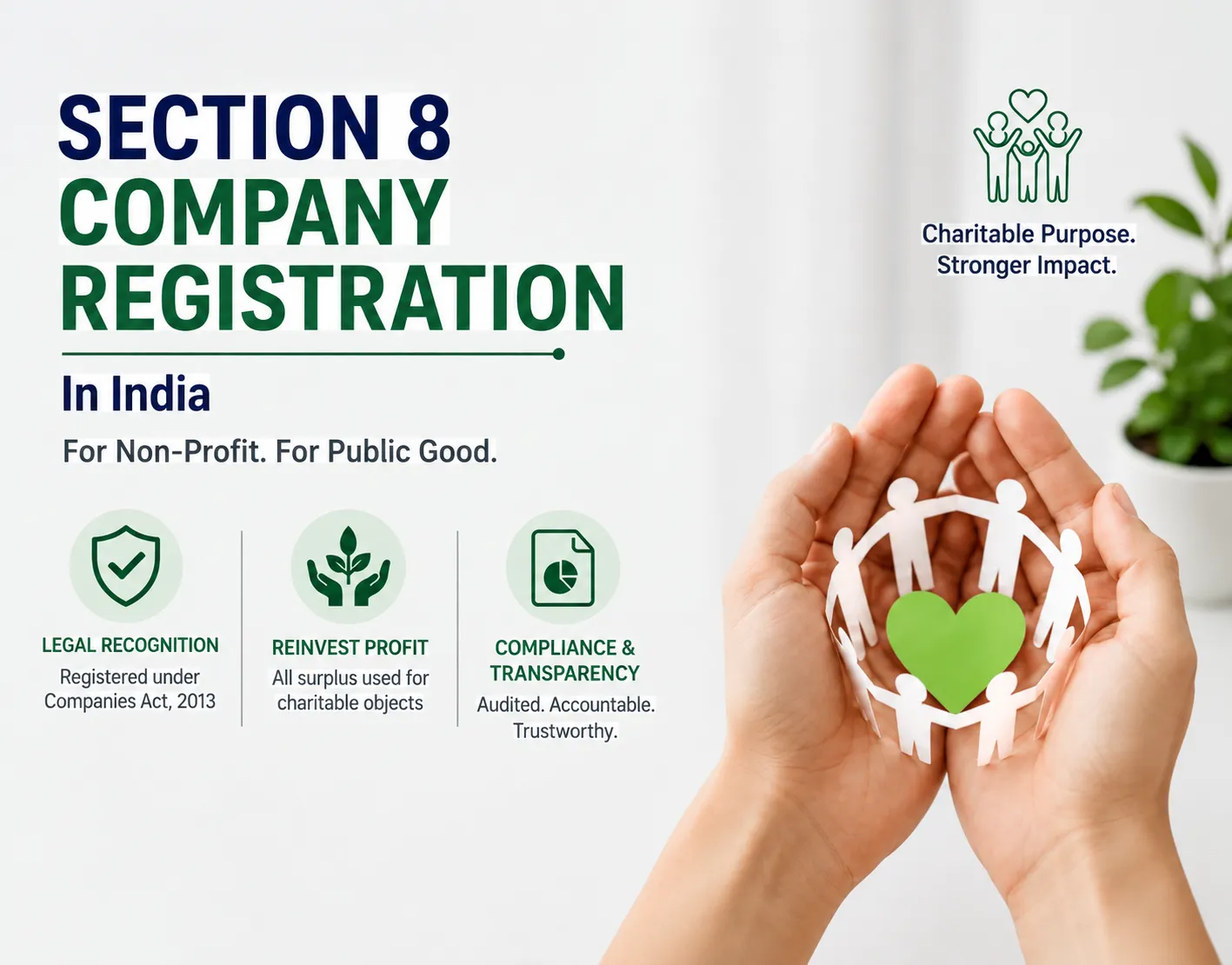
A Section 8 Company is incorporated under the Companies Act, 2013 and is designed for non-profit objectives. Unlike an ordinary commercial company, its income and profits are required to be applied toward its objectives rather than distributed as dividends.
3. Select a Suitable Name
The proposed name should comply with MCA naming requirements and appropriately reflect the organisation's objectives. MCA guidance has historically recognised terms such as Foundation, Forum, Association, Federation, Council and similar expressions for Section 8 entities.
4. Prepare MOA and AOA
The Memorandum of Association and Articles of Association are particularly important because they establish the organisation's objectives, governance structure and operating framework.
5. File Incorporation Application
New Section 8 companies obtain their licence through the integrated MCA incorporation process. MCA's incorporation FAQs confirm that INC-12 is not required for obtaining the licence for a new Section 8 Company, as the process was integrated into SPICe+ from February 2020.
6. Receive Incorporation Documents
After approval, the organisation receives its corporate registration details and applicable incorporation documents.
7. Apply for Additional Registrations
Depending on the organisation's activities, consider:
- 12AB registration
- 80G registration
- CSR registration/eligibility
- NGO Darpan registration
- GST registration, where applicable
- Other sector-specific registrations
8. Create a Compliance Calendar
Do not stop compliance after incorporation. Track:
- Annual MCA filings
- Financial statements
- Board meetings
- Director-related compliance
- Income-tax filings
- CSR-related requirements
- Donation records
- 12AB/80G compliance, where applicable
Section 8 Company vs Trust vs Society: Which Is Better?
There is no universal answer because the correct structure depends on the organisation's purpose, funding model, governance requirements and long-term plans.
A Section 8 Company may be suitable when founders want a structured corporate framework, separate legal identity and formal governance.
A Trust can be appropriate for certain charitable or philanthropic activities where the founders prefer a trust-based governance structure.
A Society may be suitable for organisations that want a member-based structure for social, cultural, educational or community activities.
Before choosing a structure, consider:
- Who will control the organisation?
- How many founders/members are involved?
- Will the organisation seek CSR funding?
- Will it receive government grants?
- Will it work across multiple states?
- Will it need strong corporate governance?
- Will it seek institutional or international partnerships?
- What tax registrations will be required?
- What annual compliance can the organisation manage?
- Does the proposed activity fit the legal objects?
For organisations specifically considering a corporate non-profit structure, you can explore CertifyKaro's Section 8 Company Registration service.
Why Section 8 Companies Should Watch the Corporate Laws Bill 2026
The Corporate Laws (Amendment) Bill, 2026 is important because it proposes changes across the Companies Act and LLP framework.
The JPC report supports several reforms aimed at simplifying compliance and improving corporate governance. It also recommended changes concerning CSR, including raising certain CSR-related thresholds and extending certain timelines. However, these recommendations should not be treated as automatically applicable law until the amendment is enacted and the relevant provisions come into force.
This is particularly important for Section 8 companies.
The JPC specifically did not recommend exempting Section 8 companies from CSR requirements.
Therefore, organisations should not change their existing compliance approach based solely on headlines such as “CSR rules relaxed” or “Section 8 companies exempted.”
Instead, follow this rule:
Bill → Parliamentary approval → Presidential assent → Notification/commencement → Actual compliance change.
Until the relevant legal process is completed, continue following the applicable existing provisions.
You can also read CertifyKaro's latest Section 8 Company Registration 2026 guide for the registration and compliance basics.
Common Section 8 Company Compliance Mistakes
Many organisations focus heavily on obtaining the certificate but overlook post-incorporation compliance.
Common mistakes include:
- Treating Section 8 registration as the same as 12AB or 80G registration.
- Assuming Section 8 status automatically provides tax exemption.
- Accepting CSR funds without checking eligibility.
- Not maintaining proper books of accounts.
- Missing annual MCA filings.
- Using objects in actual operations that are not properly aligned with constitutional documents.
- Distributing surplus or benefits improperly.
- Failing to maintain donation records.
- Ignoring changes in Companies Act rules.
- Treating proposed Bills as final law.
A Section 8 Company should be managed as a regulated corporate entity with a non-profit objective, not simply as an NGO certificate.
For organisations that are already registered, a periodic compliance review can help identify gaps before they become notices or penalties.
FAQs About Section 8 Company Registration 2026
1. Is Section 8 Company registration still beneficial in 2026?
Yes. Section 8 companies remain a recognised corporate structure for charitable and non-profit objectives. They can provide a formal legal identity and structured governance and may be suitable for organisations seeking institutional partnerships, grants or CSR-related opportunities, subject to applicable requirements.
2. Are Section 8 companies exempt from CSR requirements in 2026?
The JPC reviewing the Corporate Laws (Amendment) Bill, 2026 did not recommend exempting Section 8 companies from CSR requirements. However, the Bill and committee recommendations should be distinguished from the law currently in force.
3. Can a Section 8 Company receive CSR funding?
Yes, an eligible Section 8 Company can act as a CSR implementing agency subject to applicable legal and registration requirements. Section 8 registration alone should not be treated as an automatic guarantee of CSR funding.
4. Can a Section 8 Company earn profit?
A Section 8 Company can generate income and surplus from legitimate activities, but its profits must be applied toward its approved objectives and cannot be distributed to members as dividends.
5. Is INC-12 required for new Section 8 Company registration?
No. MCA's incorporation FAQs state that the Section 8 licence for a new company is issued through the SPICe+ incorporation process and INC-12 is not required for a new Section 8 company.
SEO Keywords
Primary Keywords:
- Section 8 Company Registration
- Section 8 Company 2026
- Section 8 Company Registration 2026
- Section 8 Company
Secondary Keywords:
- Section 8 Company Registration Process
- Section 8 Company Benefits
- Section 8 Company CSR
- Section 8 Company Compliance
- NGO Registration India
- Non Profit Company Registration
- Section 8 Company Documents
- MCA Section 8 Company
- CSR Registration for NGO
- Section 8 Company CSR Funding
- NGO Company Registration
Final Takeaway
The latest Section 8 Company 2026 developments show that non-profit organisations should focus on both opportunities and compliance.
The JPC's August 2026 report is particularly important because it did not recommend a blanket exemption for Section 8 companies from CSR requirements, while the broader Corporate Laws (Amendment) Bill continues to move through the legislative process.
At the same time, the May 2026 CSR amendment has opened a new route involving Social Stock Exchange ZCZP instruments, potentially creating another structured channel for social-impact funding.
For founders planning an NGO, foundation or social enterprise, the practical approach is simple: choose the right legal structure, prepare clear charitable objects, complete MCA incorporation correctly and maintain ongoing statutory, tax and CSR-related compliance.
Planning to Register a Section 8 Company?
CertifyKaro se contact karo for assistance with Section 8 Company Registration and related business compliance.
Call/WhatsApp: +91 70422 52542
Official sources: Ministry of Corporate Affairs (MCA) · Press Information Bureau (PIB) · Income Tax Department