Learn the latest Private Company Registration 2026 updates, MCA reforms, documents, process and compliance requirements. CertifyKaro se contact karo today.
Introduction
Private Company Registration remains one of the most preferred ways to start a scalable business in India. In 2026, the Ministry of Corporate Affairs (MCA) is continuing its focus on Ease of Doing Business, digital incorporation and reducing unnecessary compliance for companies.
One important development came in April 2026, when MCA invited public comments on proposed amendments to the Companies (Incorporation) Rules, 2014 and wider rationalisation of the filing framework. The consultation covered the complete corporate lifecycle, including entry, operations and exit.
At the same time, director KYC requirements have been simplified, with the annual KYC requirement replaced by an abridged KYC intimation once every three years from the prescribed effective date.
For entrepreneurs planning Private Company Registration in India, these developments matter because incorporation is not only about obtaining a Certificate of Incorporation. Choosing the right structure, preparing correct documents and understanding post-incorporation compliance can prevent costly mistakes later.
MCA Company Incorporation Updates in 2026
The biggest current development for people planning company incorporation is MCA's review of the Companies (Incorporation) Rules, 2014.
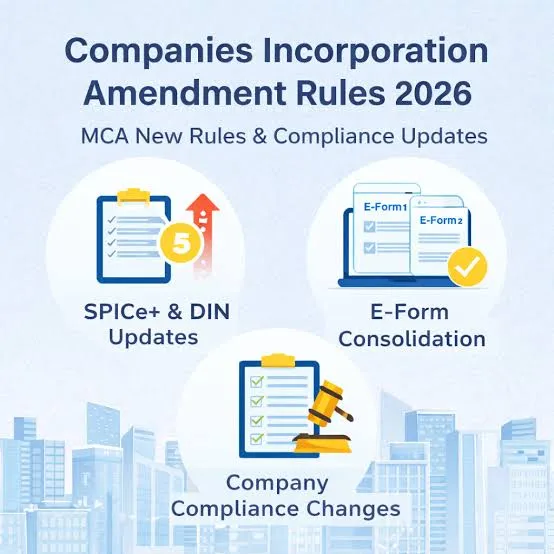
On 17 April 2026, MCA announced a draft Companies (Incorporation) Amendment Rules, 2026 for public consultation. The objective was to review incorporation-related rules and rationalise the filing framework under the Companies Act, 2013. MCA also sought stakeholder views on simplifying compliance across the company's complete lifecycle.
This development is important, but businesses should distinguish between a draft proposal and a final notified rule. A consultation announcement does not automatically mean that every proposed change is already applicable.
Another important 2026 reform concerns director KYC. MCA announced that the annual KYC requirement was replaced by a simpler KYC intimation once every three years, with the amendment effective from 31 March 2026. Directors who had already completed KYC were covered, with their next KYC due by 30 June 2028 under the announced framework.
MCA has also continued expanding its institutional framework. New Regional Directorates and Registrar of Companies offices were introduced in 2026 to improve regulatory facilitation and support the growing business environment.
For founders, the practical message is simple: company incorporation is becoming increasingly digital, but accurate documentation and ongoing compliance remain essential.
What Is the Process for Private Limited Company Registration in India?
A private limited company is incorporated under the Companies Act, 2013. MCA's digital incorporation system uses integrated forms to streamline several registrations required when starting a company.
The government's existing incorporation framework uses SPICe+ and linked forms, allowing entrepreneurs to handle services such as name reservation, incorporation, PAN, TAN, DIN and certain linked registrations through the MCA system.
A typical incorporation journey involves:
- Choosing the appropriate company structure.
- Selecting and checking a suitable company name.
- Identifying directors and shareholders.
- Obtaining Digital Signature Certificates where required.
- Preparing the Memorandum of Association (MOA) and Articles of Association (AOA).
- Preparing registered-office documentation.
- Filing the applicable incorporation forms with MCA.
- Responding to any resubmission or clarification raised by the Registrar.
- Receiving the Certificate of Incorporation after approval.
- Completing post-incorporation requirements applicable to the company.
The most common problem is not the online form itself. It is a mismatch between documents, proposed business activities, shareholder information, registered-office details or director information.
Therefore, before submitting an application, founders should verify every document and ensure that the proposed company structure actually matches their business requirements.
For professional assistance, you can explore Private Company Registration by CertifyKaro.
Private Limited Company Registration Checklist: What Do You Need?
Before starting the application, founders should prepare their documents and basic business information. Proper preparation can reduce unnecessary resubmissions and delays.
1. Decide the company structure
Confirm that a private limited company is suitable for your business. It is generally preferred by founders who want a separate legal entity, limited liability and a structure suitable for bringing in additional shareholders or investors.
2. Finalise directors and shareholders
Decide who will become directors and shareholders and determine their proposed shareholding.
3. Prepare identity and address documents
Commonly required documents can include:
- PAN card
- Aadhaar or other acceptable identity proof
- Address proof
- Passport-size photographs
- Email ID and mobile number
- Director-related declarations and details
CertifyKaro's current Private Company Registration service page also lists PAN, Aadhaar, address proof, registered-office proof, NOC and photographs among its document requirements.
4. Arrange registered-office proof
The company needs a valid registered office. Depending on the circumstances, appropriate ownership, rental/lease and utility or authorisation documents may be required.
If you are using a professional business address solution, make sure the address and supporting documentation satisfy applicable MCA requirements rather than choosing an address only because it is inexpensive.
5. Select the business activity carefully
Your proposed objects and business activity should accurately describe what the company intends to do. Incorrect or overly broad information can create problems during incorporation or later when opening bank accounts, applying for licences or entering into contracts.
6. File the incorporation application
The incorporation application and linked documents are submitted through the MCA's online system. The government has been steadily moving company services toward digital, integrated and more streamlined processes.
7. Complete post-incorporation compliance
Getting the Certificate of Incorporation is not the final step. Depending on the company and its activities, founders may need to address PAN/TAN, bank account opening, statutory registers, accounting, tax registrations and other applicable compliance.
Why Should You Register a Private Limited Company in 2026?
A private limited company can provide a more formal structure for businesses that plan to grow, hire employees, raise investment or build long-term operations.
Some key advantages include:
- Limited liability: Shareholders generally have limited liability according to the legal structure and applicable law.
- Separate legal identity: The company is legally distinct from its shareholders.
- Business credibility: A registered company structure can help establish credibility with customers, vendors and institutional partners.
- Investment readiness: The structure can be suitable for bringing in shareholders and investors, subject to applicable law.
- Business continuity: The company's existence is not normally dependent on the continued existence of a particular shareholder.
- Growth opportunities: A formal corporate structure can support expansion, hiring and additional registrations.
- Startup ecosystem access: Eligible private limited companies may also explore DPIIT recognition and relevant government startup benefits separately.
If your company is eligible and innovation-focused, you can also explore Startup India Registration. A private limited company can be one of the eligible entity structures for DPIIT recognition, subject to the applicable criteria.
Common Problems During Private Company Registration
Many incorporation applications face delays because founders focus only on filling the form instead of checking the complete documentation.
Name-related issues
A proposed name may face problems because it resembles an existing company, LLP, trademark or otherwise does not satisfy the applicable naming requirements.
Solution: Check the proposed name carefully before filing and consider trademark availability separately.
Address-document mismatch
Differences between the registered-office address, utility bill, rent agreement, NOC or other supporting documents can result in clarification or resubmission.
Solution: Keep the complete address identical across documents wherever applicable.
Incorrect director details
Errors in PAN, address, DIN-related information or identity documents can create unnecessary complications.
Solution: Cross-check all director information before submission.
Choosing the wrong business structure
Some founders select a private limited company simply because it is popular without considering whether an LLP, OPC or another structure better suits their circumstances.
Solution: Compare ownership, compliance, investment plans, liability and future expansion before incorporation.
Assuming incorporation ends compliance
This is one of the most common mistakes. Registration creates the company, but it does not eliminate continuing legal, accounting and tax responsibilities.
Solution: Prepare a compliance calendar immediately after incorporation.
FAQs
1. What is the cost of Private Company Registration in India in 2026?
The total cost depends on factors such as government filing fees, stamp duty, authorised capital, state-specific charges and professional assistance. It is therefore better to calculate the cost based on the proposed company structure and state instead of relying on one fixed nationwide figure.
2. How many directors are required for a private limited company?
A private company generally requires at least two directors under the Companies Act, 2013. The specific requirements should be checked based on the company's circumstances and applicable law.
3. How long does Private Limited Company Registration take?
The timeline can vary depending on name approval, document accuracy, MCA processing and whether the application receives a resubmission or clarification. Complete and consistent documentation can help avoid unnecessary delays.
4. Can a startup register as a Private Limited Company?
Yes. A private limited company is one of the business structures commonly used by startups. However, incorporation and DPIIT Startup India recognition are separate processes, and the startup must satisfy the applicable recognition conditions.
5. Is annual compliance required after Private Company Registration?
Yes. Incorporation does not end the company's compliance obligations. Companies generally have continuing requirements relating to financial statements, annual returns, accounting records, meetings, tax and other applicable statutory filings.
SEO Keywords
- Private Company Registration
- Private Limited Company Registration
- Private Limited Company Registration in India
- Company Registration in India
- Private Company Registration 2026
- Pvt Ltd Company Registration
- Private Limited Company Registration Online
- MCA Company Registration
- MCA Registration
- Company Incorporation
- Private Company Incorporation
- New Company Registration
- Company Registration Process
- Documents Required for Private Limited Company
- Cost of Private Limited Company Registration
Internal Links
For related business registration and startup services:
- Private Company Registration – CertifyKaro
- Startup India Registration – CertifyKaro
- CertifyKaro Business Registration Services
Authority & Government Sources
- Ministry of Corporate Affairs (MCA) – Companies and incorporation-related services
- Press Information Bureau (PIB) – MCA's 2026 incorporation-rule consultation
- Press Information Bureau – MCA director KYC reform
- Press Information Bureau – MCA Ease of Doing Business initiatives
- MCA SPICe+ incorporation framework
CTA
Planning to start your company and confused about documents, MCA forms, name approval or incorporation compliance?
CertifyKaro se contact karo for assistance with Private Company Registration and related business compliance services.