Learn LLP Registration 2026 updates, MCA rules, documents, process, benefits and compliance requirements. CertifyKaro se contact karo for LLP assistance.
Introduction
LLP Registration has become a popular choice for entrepreneurs, professionals and small businesses that want the flexibility of a partnership with the benefit of limited liability. In 2026, the Ministry of Corporate Affairs (MCA) continues to focus on digital filings, easier compliance and improving the overall business registration process.
One of the important developments is the continued use of the MCA21 Version 3 platform, where the LLP Module is already operational along with other digital corporate services. MCA reported that around 3.84 crore filings were made through MCA21 between 2021 and 2025, showing the scale of India's shift toward online corporate compliance.
MCA has also continued its Ease of Doing Business reforms, including simplification of filings, centralised processing and measures intended to reduce unnecessary compliance burdens. For someone planning LLP Registration in India, understanding these changes is important before starting the incorporation process.
LLP Registration in India: What Has Changed in 2026?
The major current trend is not a single new LLP registration form but the continued digitisation and rationalisation of MCA compliance.
MCA21 V3 now handles LLP-related services through its dedicated LLP Module. The system provides online filing, real-time validation and pre-filled master data in relevant forms, helping reduce manual errors and unnecessary resubmissions.
For new LLPs, FiLLiP (Form for incorporation of Limited Liability Partnership) remains the key integrated incorporation form. The MCA's current FiLLiP instruction kit states that the form can cover name reservation, allotment of DPIN, LLP incorporation/LLPIN, consent of designated partners, certain conversions and PAN/TAN allocation.
Another important development is MCA's broader compliance-reform agenda. In February 2026, an IICA-led advisory group was constituted to examine simplification of compliance filings, rationalisation of e-forms and digital governance.
MCA has also expanded its regional regulatory structure. From 16 February 2026, new Regional Directorates and Registrar of Companies offices became operational, including a separate Northern Region-I headquartered in New Delhi covering Delhi and Uttar Pradesh.
These developments show a clear direction: LLP registration and compliance are increasingly digital, centralised and technology-driven. However, entrepreneurs still need to submit accurate information and maintain ongoing statutory compliance.
What Is an LLP and Who Should Choose LLP Registration?
A Limited Liability Partnership (LLP) is a separate legal business structure governed by the Limited Liability Partnership Act, 2008. It combines elements of a traditional partnership with limited liability protection.
An LLP can be particularly suitable where two or more people want to operate a business together but do not want the traditional unlimited liability associated with an ordinary partnership.
An LLP may be considered by:
- Consultants and professional service providers
- Agencies and small businesses
- Family-owned businesses
- Technology and service startups
- Businesses operated by two or more founders
- Professionals looking for a flexible partnership structure
- Businesses that do not immediately require an equity-investment structure like a private limited company
The structure can offer flexibility in internal management because the rights and responsibilities of partners can generally be established through the LLP Agreement, subject to applicable law.
However, LLP registration should not be selected simply because it has fewer formalities than a private company. Founders should consider their investment plans, ownership structure, funding requirements, taxation, partner responsibilities and future expansion before deciding.
If the business is expected to raise equity investment from multiple investors, a private limited company may sometimes be more appropriate. If the business is primarily partner-driven, an LLP may provide a more practical structure.
How to Register an LLP Online in India?
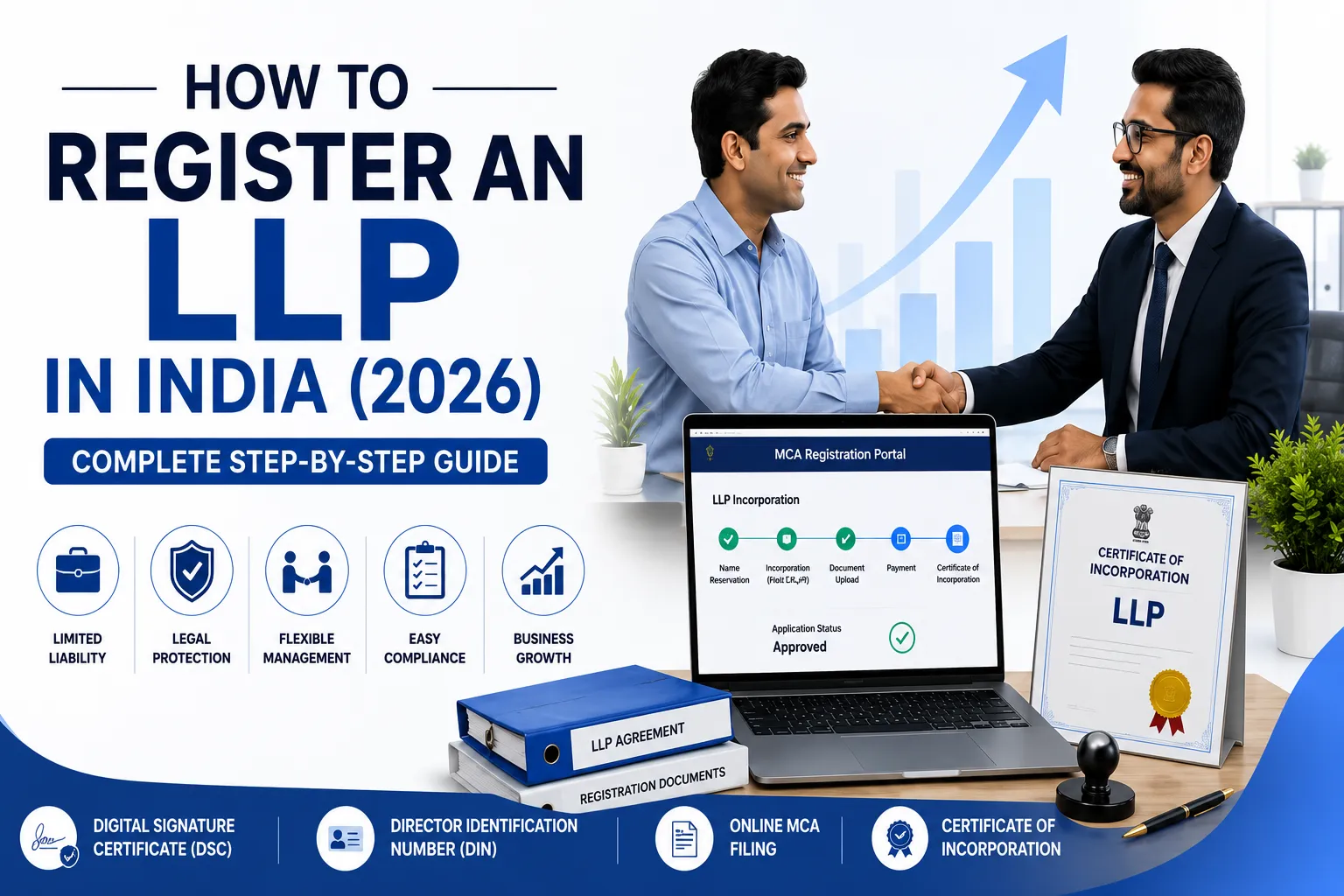
The MCA's FiLLiP system has been designed to simplify LLP incorporation by bringing several incorporation-related services into a single webform.
According to MCA's current FiLLiP instruction kit, the form can facilitate name reservation, DPIN application, LLP registration and PAN/TAN allocation. The form also requires at least two designated partners, with at least one being resident in India under the applicable requirements.
The basic process can be understood as follows:
- Decide the LLP structure
Identify the proposed partners, designated partners, contribution and business activities. - Select an LLP name
Choose a name that complies with applicable MCA naming requirements and does not create conflicts with existing entities or protected names. - Arrange Digital Signature Certificates
The required persons must have valid DSCs for electronic filing. - Prepare partner information
Keep identity, address and other required information ready for all proposed partners/designated partners. - Prepare registered-office documents
Keep appropriate proof of the proposed registered office, along with NOC/authorisation and supporting documents where required. - File FiLLiP
Submit the LLP incorporation application through the MCA portal with the required attachments. - Respond to MCA clarification, if any
If the Registrar raises a resubmission or clarification, respond within the prescribed timeline. - Receive LLPIN and incorporation approval
Once approved, the LLP receives its identification number and incorporation documentation. - Execute the LLP Agreement
The partners should prepare and execute the LLP Agreement and complete applicable stamp-duty requirements according to the relevant state law. - Complete post-incorporation compliance
Maintain books, statutory records and complete applicable MCA, tax and other regulatory filings.
For professional support, you can explore LLP Registration by CertifyKaro.
What Documents Are Required for LLP Registration?
Preparing documents correctly is one of the easiest ways to avoid delays.
Generally, documents and information may include:
- PAN card of partners/designated partners
- Identity proof
- Address proof
- Passport-size photographs
- Mobile number and email ID
- Proof of registered office
- Rent/lease agreement, where applicable
- Owner's NOC, where applicable
- Utility bill or other acceptable address proof
- Digital Signature Certificate
- Details of proposed business activity
- Details of partners' contribution
- Consent/declarations required under the LLP incorporation process
The exact documents can vary depending on whether the partners are individuals, foreign nationals or body corporates.
The biggest practical mistake is submitting documents that contain inconsistent names, addresses or dates.
Problem-solving tip: Before filing, compare the spelling of every partner's name, residential address, PAN details and registered-office address across all documents. Even a small mismatch can result in clarification or resubmission.
LLP Registration Checklist for Entrepreneurs
Before submitting the incorporation application, use this checklist:
1. Decide partners and contribution
Finalise who the partners are and how much each partner will contribute.
2. Select the business activity
Clearly define what the LLP will actually do. This information should be consistent with the proposed objects/business activities.
3. Check the proposed name
Avoid names that are identical or deceptively similar to an existing LLP, company, trademark or restricted name.
4. Verify partner documents
Check:
- PAN details
- Identity proof
- Residential address
- Email ID
- Mobile number
- Photograph
- DSC status
5. Verify registered-office proof
Make sure the address documents support the exact proposed LLP office address.
6. Prepare the LLP Agreement
The agreement is important because it defines the relationship between partners and the internal functioning of the LLP.
7. Check state stamp duty
Stamp duty on the LLP Agreement can depend on the applicable state law and other factors.
8. File FiLLiP correctly
Ensure the information entered into the MCA form matches the supporting documents.
9. Monitor the MCA application
Do not ignore MCA notifications or resubmission requirements.
10. Create a compliance calendar
After incorporation, note all applicable filing deadlines instead of waiting until the last date.
LLP Compliance After Registration: What Should You Not Miss?
Registration is only the beginning. An LLP has continuing compliance responsibilities.
One important annual filing is LLP Form 11, the Annual Return of the LLP. MCA's current Form 11 instruction kit states that every LLP is required to file its annual return within 60 days of closure of its financial year.
Depending on the LLP's circumstances, financial statements/accounting-related filings and tax compliance may also apply.
Common areas that should be monitored include:
- Annual Return filing
- Statement of Account and Solvency
- Income-tax return
- Maintenance of books and records
- Changes in partners/designated partners
- Changes in registered office
- LLP Agreement updates
- Event-based MCA filings
- GST compliance, if applicable
- TDS and other tax requirements, if applicable
A common mistake is to think that an LLP automatically has “no compliance” because it is more flexible than a company.
That is incorrect.
An LLP can have fewer corporate formalities in certain areas, but it still has statutory filing obligations. Missing deadlines can result in additional fees and other consequences.
LLP vs Private Limited Company: Which Is Better?
There is no single answer for every business.
An LLP can be useful when the business is partner-driven and flexibility is important. A private limited company may be more suitable when founders plan to raise equity investment, issue shares or build a structure designed for institutional investors.
LLP may be suitable when:
- There are two or more active partners.
- The business is service or professional oriented.
- Flexible management is important.
- Founders want limited liability.
- External equity investment is not the immediate priority.
Private Limited Company may be suitable when:
- The founders plan to raise equity funding.
- The business expects multiple investors.
- Share-based ownership is important.
- The company intends to build an investor-focused structure.
- Future fundraising or ESOPs are important.
Choosing the structure at the beginning can save significant restructuring work later.
If you are comparing business structures, you can also explore Private Company Registration before making a final decision.
What Are the Benefits of LLP Registration in 2026?
LLP registration can provide several practical advantages:
- Separate legal identity: The LLP has its own legal identity separate from its partners.
- Limited liability: Partners generally receive limited liability protection subject to the LLP Act and applicable circumstances.
- Flexible management: The LLP Agreement can establish partner rights and responsibilities.
- Suitable for professionals: It can work well for consulting, advisory and professional businesses.
- Digital incorporation: MCA's FiLLiP system makes incorporation largely online.
- Lower structural complexity: Compared with a company, an LLP may have fewer corporate governance formalities in certain areas.
- Business continuity: The LLP can continue independently of changes in individual partners, subject to the agreement and law.
- Scalability: An LLP can grow by admitting additional partners according to the LLP Agreement and applicable requirements.
MCA's broader Ease of Doing Business reforms also include the concept of a small LLP, which was introduced to provide eligible smaller LLPs with lesser compliance requirements and reduced costs.
Current MCA Direction: What Should New LLP Founders Expect?
The current MCA trend is toward digital-first compliance, centralised processing and rationalised filings.
MCA has stated that its V3 platform is intended to improve Ease of Doing Business and strengthen transparency and compliance. The platform includes a dedicated LLP Module and digital services for corporate filings.
At the same time, the government's 2026 consultation work on rationalising corporate filings shows that further changes may be considered.
However, founders should be careful with online articles claiming that “all LLP compliance has been removed” or that a particular proposed MCA reform is already mandatory.
Always distinguish between:
- Existing law
- MCA circulars and notifications
- Draft amendments
- Public consultation proposals
- Announced future reforms
For an LLP being incorporated today, compliance should be based on the rules and forms actually applicable at the time of filing.
FAQs
1. What is LLP Registration in India?
LLP Registration is the legal process of incorporating a Limited Liability Partnership with the Ministry of Corporate Affairs under the Limited Liability Partnership Act, 2008. After approval, the LLP receives an LLP Identification Number (LLPIN).
2. What is the minimum number of partners required for an LLP?
An LLP generally requires at least two designated partners at incorporation, with at least one designated partner required to be resident in India under the applicable rules. MCA's FiLLiP instructions specifically provide for at least two designated partners for incorporation.
3. Is an LLP better than a private limited company?
It depends on the business. LLPs can be suitable for partner-driven and professional businesses seeking flexibility and limited liability, while private limited companies may be better suited to businesses planning equity fundraising and investor participation.
4. What documents are required for LLP Registration?
Typical documents include PAN and identity/address proofs of partners, photographs, registered-office proof, NOC or authorisation where applicable, DSC and other incorporation declarations. Requirements can vary based on the partners and proposed office.
5. What annual compliance is required for an LLP?
An LLP generally has annual filing requirements including Form 11 Annual Return and applicable financial statement/accounting and income-tax compliance. MCA states that LLP Form 11 is to be filed within 60 days of closure of the financial year.
SEO Keywords
- LLP Registration
- LLP Registration in India
- LLP Registration Online
- LLP Registration 2026
- Limited Liability Partnership Registration
- LLP Company Registration
- LLP Incorporation
- LLP Registration Process
- LLP Registration Documents
- LLP Registration Fees
- LLP Agreement
- MCA LLP Registration
- FiLLiP Form
- LLP Annual Compliance
- LLP Form 11
Internal Links
- LLP Registration – CertifyKaro
- Private Company Registration – CertifyKaro
- Startup India Registration – CertifyKaro
Authority Websites
- Ministry of Corporate Affairs (MCA)
- Press Information Bureau (PIB)
- Indian Institute of Corporate Affairs (IICA)
- Limited Liability Partnership Act, 2008
- Limited Liability Partnership Rules, 2009
CTA
Planning to start an LLP and confused about the name, documents, FiLLiP form, LLP Agreement or MCA compliance?
CertifyKaro se contact karo for professional assistance with LLP Registration and related business registration services.
Call: +91 70422 52542