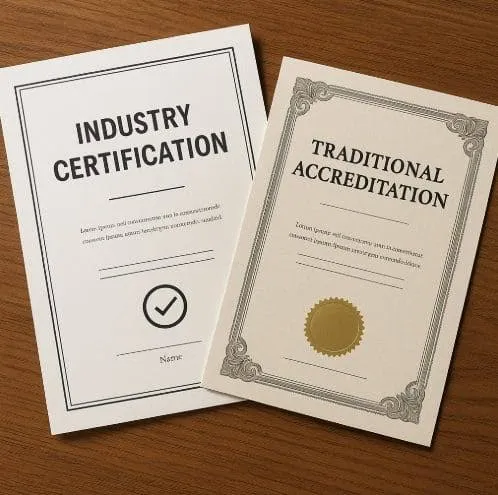
Industry Certifications have become more important than ever in 2026 as businesses face stricter quality standards, regulatory requirements, and customer Learn More.........
Introduction
Industry Certifications have become more important than ever in 2026 as businesses face stricter quality standards, regulatory requirements, and customer expectations. Recent developments in India show a strong government focus on quality control, product standardization, and global competitiveness. New BIS certification mandates, expanding Quality Control Orders (QCOs), ESG compliance requirements, and upcoming ISO standard revisions are reshaping how businesses operate. Manufacturers, exporters, MSMEs, startups, and service providers are increasingly adopting certifications to improve credibility, gain market access, and remain compliant with evolving regulations.
Whether your business operates in manufacturing, food processing, construction, electronics, healthcare, or services, industry certifications are no longer optional—they are becoming a strategic business requirement. This guide explains the latest certification trends, compliance requirements, and benefits for Indian businesses in 2026.
Why Industry Certifications Are Trending in 2026
India's compliance landscape is changing rapidly. The government is strengthening quality standards through new BIS regulations, while global buyers increasingly demand certified suppliers. Recent BIS reforms have simplified certification processes while tightening post-certification compliance requirements.
Major Certification Trends in 2026
✔ Expansion of BIS Mandatory Certification
✔ New Quality Control Orders (QCOs)
✔ Growing Demand for ISO Certifications
✔ ESG Compliance Requirements
✔ Export Compliance Standards
✔ Sustainable Manufacturing Certifications
Recent Industry Updates
- BIS certification requirements are expanding across multiple product categories.
- Government quality certification fee concessions for MSMEs are expected to continue, reducing compliance costs.
- ESG compliance is becoming a business necessity for manufacturers and exporters.
- New environmental and sustainability standards are gaining importance across industries.
Internal Links
- ISO Certification Services
- BIS Certification Registration
- MSME Registration Services
Which Industry Certifications Are Most Important in 2026?
This is one of the most searched questions by business owners.
Different industries require different certifications. However, some certifications are widely accepted across sectors and provide significant business advantages.
Top Industry Certifications
1. ISO 9001 Certification
Focuses on quality management systems and operational efficiency.
Benefits:
- Better customer satisfaction
- Improved quality control
- Increased business credibility
- Tender eligibility
2. BIS Certification
Mandatory for many regulated products sold in India.
Benefits:
- Legal compliance
- Market access
- Product quality assurance
- Consumer trust
3. ISO 14001 Certification
Environmental management certification that supports sustainability goals.
Benefits:
- Reduced environmental risks
- Better compliance
- Enhanced brand reputation
4. ISO 45001 Certification
Occupational health and safety management standard.
Benefits:
- Workplace safety improvement
- Reduced accidents
- Better regulatory compliance
5. ESG Compliance Certifications
Increasingly important for investors, exporters, and large enterprises.
Benefits:
- Improved investor confidence
- Export readiness
- Sustainability compliance
Many organizations are now adopting integrated certification systems that combine quality, safety, and environmental management.
How to Obtain Industry Certification: Step-by-Step Checklist
Follow this practical certification roadmap:
Step 1: Identify Applicable Certification
Determine whether your business requires:
- ISO Certification
- BIS Certification
- FSSAI License
- CE Marking
- ESG Compliance Framework
Step 2: Conduct Gap Analysis
Review existing processes and identify compliance gaps.
Step 3: Prepare Documentation
Create:
- Policies
- Procedures
- Quality Manuals
- Compliance Records
Step 4: Implement Required Standards
Train employees and establish necessary systems.
Step 5: Internal Audit
Verify readiness before certification assessment.
Step 6: Certification Audit
Authorized certification body conducts evaluation.
Step 7: Obtain Certification
Receive certification after successful audit completion.
Certification Readiness Checklist
✅ Business Registration Documents
✅ Process Documentation
✅ Employee Training Records
✅ Compliance Procedures
✅ Internal Audit Reports
✅ Management Review Records
Businesses that prepare systematically often achieve certification faster and at lower cost.
Frequently Asked Questions (FAQs)
1. What are industry certifications?
Industry certifications are official recognitions that verify a business complies with specific quality, safety, environmental, or regulatory standards.
2. Is BIS certification mandatory?
Yes, BIS certification is mandatory for many products covered under Quality Control Orders issued by the Government of India.
3. Which ISO certification is most popular?
ISO 9001 is the most widely adopted certification worldwide for quality management systems.
4. Do MSMEs benefit from certifications?
Yes. Certifications improve credibility, customer trust, export opportunities, and eligibility for government tenders.
5. Are ESG certifications important in 2026?
Yes. ESG compliance is becoming increasingly important due to investor expectations, sustainability regulations, and international trade requirements.
SEO Keywords Used
Industry Certifications, ISO Certification, BIS Certification, Quality Certification India, Industry Compliance, ESG Certification, ISO 9001 Certification, ISO 14001 Certification, ISO 45001 Certification, BIS Registration, Quality Control Order, MSME Certification, Manufacturing Certification, Business Compliance India, Industrial Standards
CTA
Need Help with Industry Certifications?
CertifyKaro se contact karo
📞 Call/WhatsApp: 70422 52542
✔ ISO Certification
✔ BIS Certification
✔ MSME Registration
✔ Startup Registration
✔ Compliance Consulting
✔ End-to-End Certification Support
Get expert assistance from CertifyKaro and simplify your certification journey today.