Someone has opposed your trademark application? Learn about the third party trademark opposition process in India, including legal deadlines, government fees, required documents, counterstatement and ways to defend your brand.
Copyright Registration in India: Process, Fees & Benefits
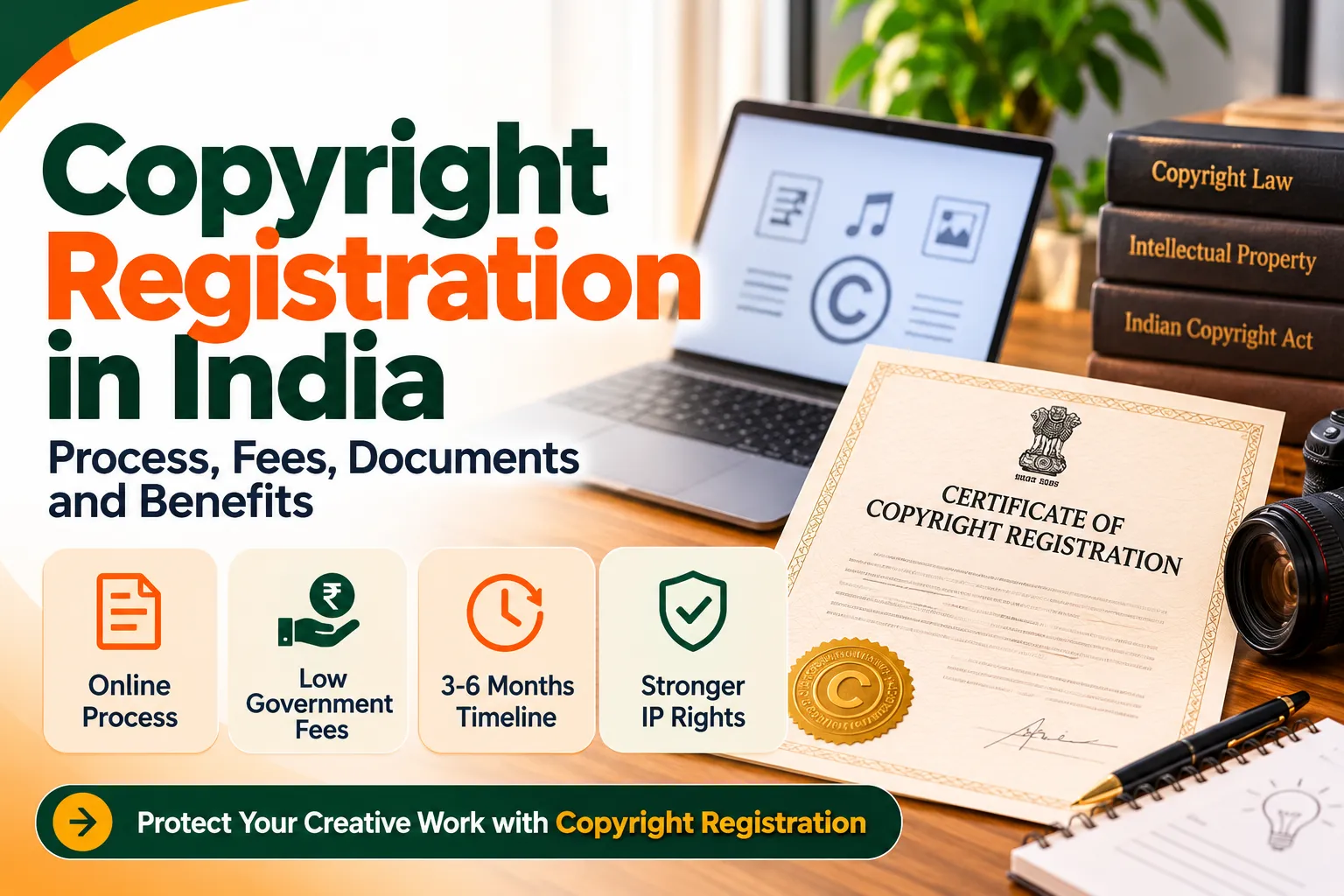
Copyright Registration is an important way to establish an official record of ownership of your original creative work in India. Copyright protection is governed by the Copyright Act, 1957, which protects original literary, artistic, musical and dramatic works, cinematograph films and sound recordings. Although copyright protection generally starts automatically when an original work is created, registration provides an official record that can help establish ownership in legal disputes.
What Is Copyright Registration?
Copyright registration is the process of recording details of an original creative work in the Register of Copyrights maintained by the Copyright Office in India.
It helps establish an official record of the work, its author and the person claiming ownership.
Under the Copyright Act, 1957, copyright protects the expression of original ideas rather than the ideas themselves.
For example:
-
If you write an original book, copyright protects your written content.
-
If you design a logo or illustration, copyright may protect its original artistic expression.
-
If you compose an original song, copyright protects the musical composition and related original work.
-
If you develop software, copyright can protect the original computer program.
-
If you create a video or film, copyright can protect the cinematograph film.
One important thing to understand is that copyright registration is not compulsory to obtain copyright protection. Copyright generally comes into existence as soon as an original work is created. However, registration and the corresponding entries in the Register of Copyrights serve as prima facie evidence in disputes concerning ownership.
Why Is Copyright Registration Important for Your Business?
If you create original content or creative assets for your business, protecting them should be part of your intellectual property strategy.
Here are some important benefits of copyright registration.
1. Helps Establish Ownership
Copyright registration creates an official record of the work and the claimed ownership details. This can help support your position if a dispute arises.
2. Protects Original Creative Work
Copyright law provides protection against certain unauthorised uses of protected work, subject to the rights and exceptions under the law.
3. Helps in Legal Disputes
A copyright registration certificate and entries in the Register of Copyrights can serve as prima facie evidence in court proceedings relating to ownership.
4. Supports Business and Commercial Use
Businesses can protect original website content, photographs, software, marketing designs, publications and other creative materials.
5. Helps Manage Licensing and Commercial Rights
Copyright owners can license or assign their economic rights in accordance with applicable law. Proper ownership documentation makes it easier to manage these arrangements.
6. Builds Intellectual Property Value
Original creative work can become a valuable business asset. Proper documentation helps businesses manage their intellectual property more effectively.
What Types of Works Can Be Registered Under Copyright in India?
The Copyright Act, 1957 recognises different categories of creative work.
Before applying, you should identify the correct category for your work.
| Copyright category | Examples |
|---|---|
| Literary Work | Books, articles, blogs, written content, computer programs |
| Artistic Work | Paintings, drawings, photographs, illustrations and graphic designs |
| Musical Work | Original musical compositions and musical notation |
| Dramatic Work | Scripts, choreography and dramatic compositions |
| Cinematograph Film | Movies, documentaries and recorded video films |
| Sound Recording | Songs, audio recordings and recorded sound |
For example, a company may register its original website articles as literary works, promotional graphics as artistic works and original advertising videos as cinematograph films.
A website may contain different copyrightable components. Generally, each component requires a separate application rather than treating the entire website as one single copyright work.
Who Can Apply for Copyright Registration in India?
An application for copyright registration can be submitted by eligible authors, copyright owners, assignees or other persons entitled to claim the relevant rights.
The following applicants may apply, depending on their ownership and legal entitlement:
-
Individual creators and authors.
-
Artists and photographers.
-
Music composers and producers.
-
Software developers.
-
Companies and registered businesses.
-
Publishers and copyright owners.
-
Legal heirs or authorised rights holders.
If a company applies as the copyright owner rather than the author, the relevant ownership documents and the author's No Objection Certificate may be required.
The applicant should have a valid claim to the work and be able to provide supporting ownership information.
How to Apply for Copyright Registration Online in India: Step-by-Step Process
The Copyright Office provides an online filing facility through the official Copyright Office portal.
Here is how the process generally works.
Step 1: Identify Your Copyright Work
First, identify the creative work you want to register. Determine whether it falls under literary, artistic, musical, dramatic, cinematograph film or sound recording.
Make sure the work is original and that you have the legal right to apply.
Step 2: Prepare the Required Documents
Keep the work, applicant details, ownership documents and other supporting records ready.
If the applicant is not the original author, additional documents such as an assignment agreement or No Objection Certificate may be required, depending on the circumstances.
Step 3: Create an Account on the Copyright Office Portal
Visit the official Copyright Office website and create a user account if you do not already have one.
Log in using your registered credentials and select the online copyright registration facility.
Step 4: Fill Out Form XIV
Complete Form XIV, which is the prescribed application form for copyright registration under Rule 70 of the Copyright Rules, 2013.
You must provide details such as:
-
Applicant's name and address.
-
Author's name and details.
-
Title of the work.
-
Category of the work.
-
Language of the work.
-
Publication status.
-
Ownership information.
-
Other relevant particulars.
Step 5: Upload the Work and Supporting Documents
Upload the creative work in the required format along with the relevant supporting documents.
For example, artistic work may be uploaded in PDF or JPG format, while sound recordings are generally uploaded in MP3 format.
For computer programs, the prescribed source-code requirements must also be followed.
Step 6: Complete the Statement of Particulars and Further Particulars
Provide the required details in the Statement of Particulars and Statement of Further Particulars, wherever applicable.
Check all the information carefully before submission.
Step 7: Pay the Government Registration Fee
Pay the applicable government fee through the available online payment facility.
The fee depends on the category of work being registered.
Step 8: Receive the Diary Number
After successful submission, the Copyright Office generates a Diary Number.
Keep this number safe because it is used to track the application status.
Step 9: Complete the Waiting and Examination Process
Under Rule 70, the applicant must give notice to persons who claim or have an interest in the copyright or dispute the applicant's rights.
A 30-day period is provided for objections to be received by the Registrar. If an objection is filed, or the Registrar is not satisfied with the particulars, an inquiry may be conducted.
If the application passes the required checks, it proceeds through examination and further processing.
Step 10: Receive the Copyright Registration Certificate
Once the Registrar approves the application and makes the relevant entry in the Register of Copyrights, the registration process is completed.
The signed and issued register entry serves as the official registration record.
What Are the Government Fees for Copyright Registration in India?
The copyright registration fee depends on the type of work you want to register.
As per the official IP India fee schedule, the following government fees apply:
| Type of work | Government fee |
|---|---|
| Literary, Dramatic, Musical or Artistic Work | ₹500 per work |
| Literary or Artistic Work used or capable of being used in relation to goods or services | ₹2,000 per work |
| Cinematograph Film | ₹5,000 per work |
| Sound Recording | ₹2,000 per work |
These are government registration fees and do not include professional service charges.
For example, if a business wants to register an original literary work, the applicable government fee is generally ₹500 per work. If an artistic work is used or capable of being used in relation to goods or services, the applicable fee is ₹2,000.
Always check the latest official fee schedule before filing because the applicable category and nature of the work matter.
Documents Required for Copyright Registration
The documents required depend on the category of work and the applicant's ownership.
Generally, you should keep the following ready:
-
Applicant's identity and address details.
-
Details of the original author.
-
Copy of the work to be registered.
-
Title and category of the work.
-
Date and details of first publication, if applicable.
-
No Objection Certificate from the author, where required.
-
Assignment deed or ownership agreement, if applicable.
-
Power of Attorney, where applicable.
-
Supporting affidavit or declarations, if required.
-
Prescribed Form XIV and relevant statements.
For software registration, the applicant must also provide the prescribed source-code material. Generally, this means at least the first 10 and last 10 pages of the source code, or the entire source code if it contains fewer than 20 pages, without blocked-out or redacted portions.
For unpublished works, two copies of the work are required under Rule 70.
Make sure the uploaded work and ownership information are accurate to avoid discrepancies during examination.
How Long Does Copyright Registration Take in India?
The copyright registration process does not have one guaranteed completion time for every application.
After filing, the applicant receives a Diary Number. A mandatory 30-day waiting period applies to allow objections to be received.
If no objection is filed, the application proceeds for examination. If the Copyright Office identifies any discrepancy, the applicant may be asked to provide additional information or correct the application.
According to the official Copyright Office FAQ, the normal process may take approximately 2 to 3 months, depending on the application and examination requirements.
If an objection or ownership dispute arises, additional time may be required.
You should regularly track your application using the Diary Number.
Copyright Registration vs Trademark Registration: What Is the Difference?
Many business owners confuse copyright and trademark registration because both help protect intellectual property. However, they protect different things.
| Basis | Copyright Registration | Trademark Registration |
|---|---|---|
| Protects | Original creative expression | Brand identity |
| Examples | Books, music, artwork, software | Brand names, logos, slogans |
| Governing law | Copyright Act, 1957 | Trade Marks Act, 1999 |
| Authority | Copyright Office | Trade Marks Registry |
| Main purpose | Protect creative work | Protect brand identity |
For example, if you create a unique logo for your business, copyright may protect its original artistic expression, while trademark registration can protect its use as a brand identifier for specified goods or services.
Both forms of protection may be relevant to the same business asset, depending on the circumstances.
Common Mistakes to Avoid During Copyright Registration
A small mistake in your application can lead to delays or requests for additional information.
Avoid these common mistakes:
-
Selecting the wrong category of copyright work.
-
Submitting incomplete applicant or author details.
-
Applying without proper ownership documents.
-
Uploading an incorrect or incomplete copy of the work.
-
Using an incorrect title or description.
-
Ignoring the required notice to interested parties.
-
Not responding to discrepancy letters.
-
Providing incomplete source-code documents for software.
-
Assuming copyright registration protects an idea or business name by itself.
One important point: copyright generally protects original creative expression, not ideas, methods, procedures or business concepts. Names, titles and short phrases are also not ordinarily protected by copyright alone.
If you want to protect a business name or brand identity, trademark registration may be more appropriate.
Copyright Registration Services with CertifyKaro
Looking to protect your original creative work? Get professional assistance with Copyright Registration in India with CertifyKaro. Our team can help you understand the application process, documentation and filing requirements.
/services/copyright-registration
Frequently Asked Questions About Copyright Registration
1. Is copyright registration mandatory in India?
No. Copyright protection generally starts automatically when an original work is created. However, registration is useful because the certificate and entries in the Register of Copyrights can serve as prima facie evidence in ownership disputes.
2. How much does copyright registration cost in India?
The government fee depends on the type of work. For literary, dramatic, musical or artistic works, the general fee is ₹500 per work. For certain literary or artistic works used in relation to goods or services, it is ₹2,000. Cinematograph films cost ₹5,000 and sound recordings cost ₹2,000 per work.
3. How can I apply for copyright registration online?
You can apply through the official Copyright Office website. Create an account, complete Form XIV, provide the Statement of Particulars and Further Particulars where applicable, upload the work and supporting documents, pay the government fee and submit the application.
4. What is Form XIV in copyright registration?
Form XIV is the prescribed application form used to apply for copyright registration in India under Rule 70 of the Copyright Rules, 2013. It includes the application details and the relevant statements about the work and its ownership.
5. How long does copyright registration take?
The Copyright Office FAQ indicates that registration may take approximately 2 to 3 months in the normal course. However, discrepancies, objections, hearings and other examination requirements can extend the timeline.
6. Can I register an unpublished work?
Yes. Both published and unpublished works can be registered. Under Rule 70, an application for an unpublished work must be accompanied by two copies of the work.
7. Can a company apply for copyright registration?
Yes. A company can apply if it owns or is legally entitled to the copyright. Relevant ownership documents and an author's No Objection Certificate may be required depending on how the rights were acquired.
8. Does copyright registration protect my business name or logo?
Copyright may protect the original artistic expression of a logo, but it does not ordinarily protect a business name or short phrase by itself. Trademark registration is generally the appropriate route for protecting brand names and logos as commercial identifiers.
9. What is a copyright Diary Number?
A Diary Number is generated after successful submission of a copyright registration application. It helps identify and track the application during the registration process.
10. Can I register software under copyright?
Yes. Computer programs are included within literary works under the Copyright Act, 1957. The applicant must follow the prescribed source-code submission requirements when applying for software copyright registration.