Starting a business with a partner? This guide explains LLP registration in India from start to finish: who should register, the step-by-step process, costs, documents, and the Form 11 and Form 8 filings you must do every year. It also flags the mistakes new LLPs make most often.
LLP Registration in India: Process, Cost, Documents & Compliance (2026)
LLP Registration in India is a suitable option for entrepreneurs, professionals and business partners who want to start a business with limited liability and flexible management. The Limited Liability Partnership (LLP) structure combines the benefits of a traditional partnership with a separate legal identity. Before applying, it is important to understand the eligibility criteria, required documents, MCA filing process and compliance requirements to avoid unnecessary delays or application rejection.
What is an LLP?
A Limited Liability Partnership is a separate legal entity. It has its own registration number (LLPIN), can open a bank account, own property and sign contracts in its own name.
The key point is liability. If the LLP can't pay its debts, creditors go after the LLP's assets, not your personal savings or home. Each partner's risk is limited to what they've contributed. The exception is fraud. If a partner acts fraudulently, that protection doesn't hold for them. In a plain partnership firm, by contrast, partners are personally liable for everything.
Who should register an LLP?
LLPs suit chartered accountants, lawyers, architects, consultants and design studios. They also work well for small trading or service businesses with a few partners, and for family businesses that have run on trust for years and now want things in writing.
Who should skip it? Anyone planning to raise venture capital. Investors want shares, and an LLP has none to give. If you expect to raise funds within a year or two, start as a private limited company. Converting later is a hassle.
Benefits of LLP registration for small businesses
-
Lighter compliance. No board meetings, no AGM. A private limited company needs an audit from year one even if it's tiny, while an LLP is audited only once it crosses the limits mentioned below.
-
No minimum capital. Many LLPs start with a contribution of ₹10,000 to ₹50,000.
-
Flexible profit sharing. Whatever the partners agree in the LLP agreement is what applies.
-
Limited liability. Your personal assets stay out of reach of business creditors.
Who can be a partner?
You need at least two partners and there's no upper limit. Of these, at least two must be designated partners, and they have to be individuals. At least one designated partner must be resident in India, meaning they've stayed in India for 120 days or more during the financial year.
Have an NRI partner? That's fine, as long as one of the designated partners is an Indian resident. You'll also need a registered office in India. If you don't have commercial space, a virtual office address works. We've covered that in our virtual office in India guide.
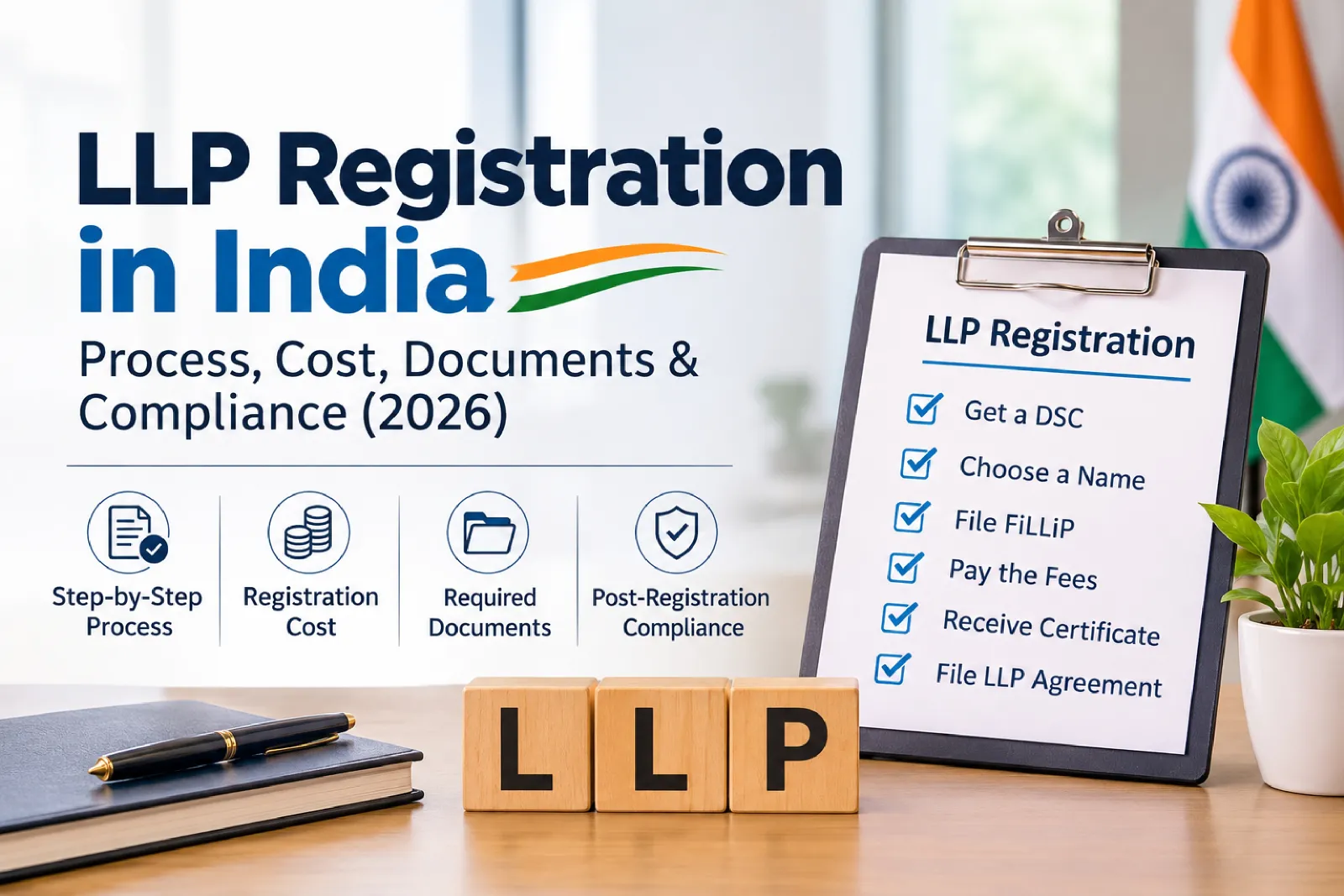
LLP registration process, step by step
Everything happens online on the MCA V3 portal. With clean documents and an easy name approval, it takes 10 to 15 working days.
-
Get a DSC. Every designated partner needs a Digital Signature Certificate. It usually takes a day or two.
-
Choose a name. You can reserve it through RUN-LLP or within the incorporation form. Check the trademark register first, because the ROC rejects names that sound too similar to existing ones.
-
File FiLLiP. This is the incorporation form. It carries partner details, contribution, registered office and supporting documents. Designated partners who don't have a DIN get one through this form, and you can apply for PAN and TAN along with it.
-
Pay the fees. The MCA fee depends on your contribution. State stamp duty applies separately.
-
Receive the certificate. You'll get the Certificate of Incorporation along with your LLPIN.
-
File the LLP agreement. Form 3 must be filed within 30 days of incorporation.
Step 6 is the one people forget.
How much does LLP registration cost?
There's no single figure, because it moves with your contribution and your state. Roughly, your costs are:
-
MCA fee for FiLLiP: starts at ₹500 for contributions up to ₹1 lakh and goes up in slabs as the contribution rises.
-
Form 3 fee: a small amount, again based on contribution.
-
Stamp duty on the LLP agreement: differs widely from state to state.
-
DSC: needed for each designated partner, usually a couple of thousand rupees or less per person.
-
Professional fees, if you're using a CA.
The takeaway: don't inflate your contribution just to look bigger. Fee slabs and the audit limit both rise with that number.
Documents required for LLP registration
For each partner: PAN, Aadhaar, passport-size photograph, email ID and mobile number. A foreign partner needs a passport and address proof, notarised or apostilled.
For the registered office: a rent agreement or ownership deed, an NOC from the owner, and a utility bill not older than two months.
Before you upload, put these three side by side. Is the address written the same way on all of them? A missing floor number has sent back more applications than you'd think.
LLP compliance after registration
This is the part that catches people out. Every LLP, even one with no business, must file two forms with the MCA each year:
-
Form 11 (annual return): by 30 May
-
Form 8 (statement of accounts and solvency): by 30 October
On top of that, the LLP files an income tax return in ITR-5. The due date is 31 July if no audit applies and 31 October if it does. An audit becomes mandatory if contribution exceeds ₹25 lakh or turnover exceeds ₹40 lakh.
Any change in partners or in the LLP agreement must also be filed with the MCA within 30 days.
A note on the MCA circular from 24 October 2026. General Circular 05/2026 lets companies file AOC-4 till 31 December 2026 and MGT-7 till 31 January 2027 without additional fees. That relief is for companies under the Companies Act. It doesn't cover LLP Form 8 or Form 11, which follow their own deadlines. If your LLP hasn't filed for FY 2025-26 yet, do it now. Late fees run from the original due date, form by form.
Mistakes to avoid
Skipping the LLP agreement. The certificate arrives and everyone relaxes. But Form 3 is still due within 30 days.
Not writing down how the partners will work. Who puts in how much, who signs what, how decisions are made, what happens in a dispute. If it isn't on paper, you'll be arguing about it later.
Overstating the contribution. Some founders quote a big number to look serious. Fees and audit limits go up with it, and you pay for it every year.
Believing an inactive LLP has nothing to file. It does. And if it stays inactive and non-compliant for long, the ROC can strike it off.
LLP registration in India with CertifyKaro
Looking for professional assistance with LLP Registration? Explore CertifyKaro's LLP Registration Services and get support with documentation, MCA filing and the incorporation process.
LLP registration FAQs
Can one person start an LLP?
No. You need at least two partners. A single founder can look at a One Person Company instead.
Is there a minimum capital?
No. You choose the contribution, but fees and the audit limit depend on it.
Can an NRI be a partner?
Yes. At least one designated partner has to be resident in India.
How long does LLP registration take?
Usually 10 to 15 working days, if the name clears easily and documents are clean.
Is an audit compulsory for an LLP?
Only if contribution is above ₹25 lakh or turnover is above ₹40 lakh.
Do I have to file returns if my LLP has no income?
Yes. Form 11 and Form 8 are due every year, regardless of activity.