BIS Certification 2026: Latest QCO Updates and Compliance
Introduction
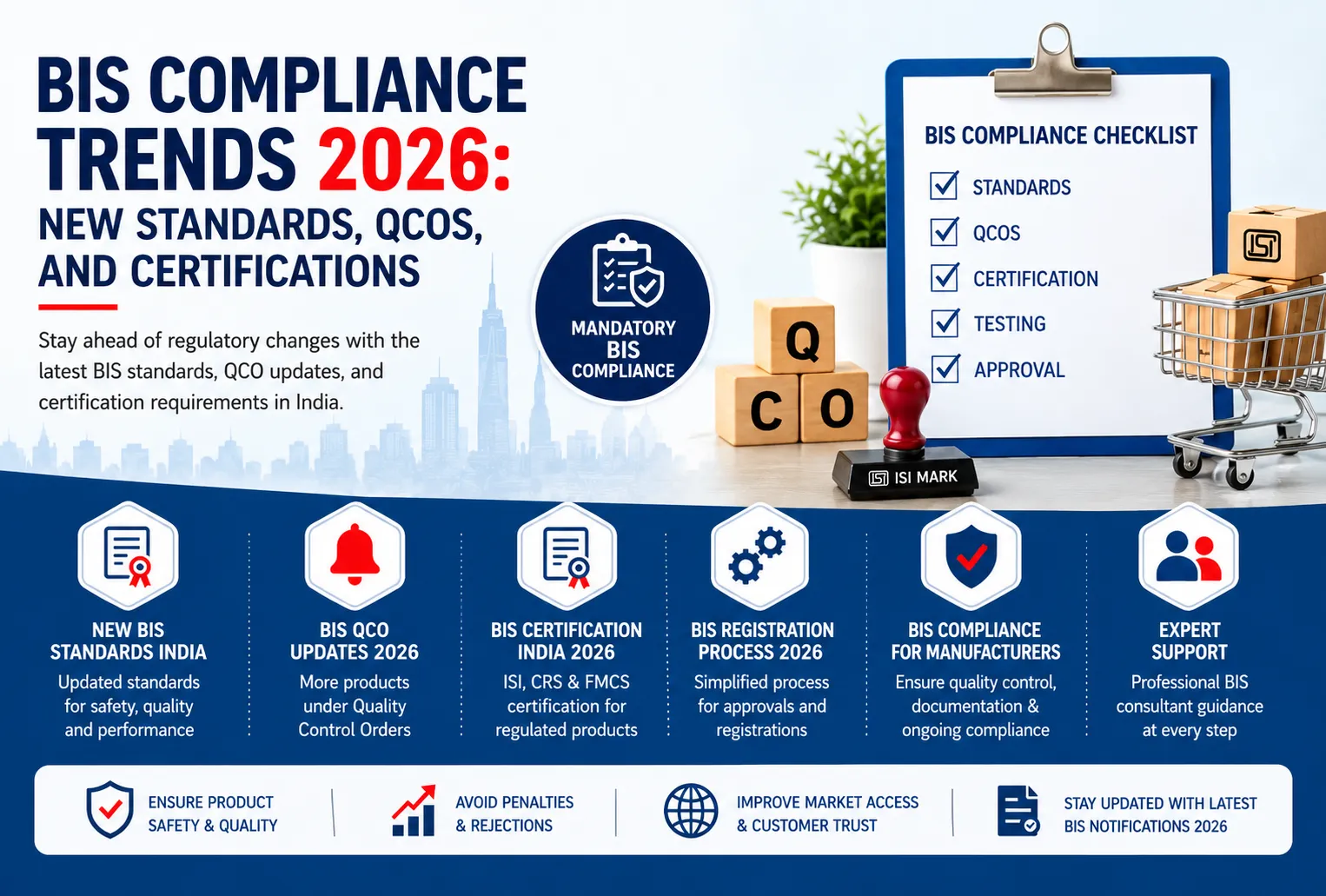
BIS certification 2026 is an important compliance consideration for Indian manufacturers, importers, brands and suppliers dealing in regulated products. The Bureau of Indian Standards (BIS) establishes Indian Standards and operates product certification schemes to support product quality, safety and regulatory compliance.
In India, BIS certification is generally voluntary unless a product is covered by a mandatory requirement, such as a Quality Control Order (QCO) or another applicable government order. Businesses must identify the correct Indian Standard, certification scheme and implementation date before manufacturing, importing or selling a regulated product.
This guide explains the latest BIS certification updates, QCO deadlines, eligibility considerations, documents and application steps that businesses should review in 2026.
Latest BIS Certification Updates in 2026
BIS publishes official information about products covered under compulsory certification and QCOs notified for future implementation. The applicable requirements vary by product category, Indian Standard and government notification.
As of October 2026, businesses should pay particular attention to the following developments.
1. QCO implementation dates in October 2026
The official BIS schedule lists several product categories with implementation dates in October 2026. The published schedule includes certain industrial tools, aluminium products and electrical appliances.
Examples of products listed for implementation from 1 October 2026 include:
-
General-purpose and heavy-duty pipe wrenches.
-
Open-jaw and ring spanners.
-
Certain adjustable and chain pipe wrenches.
-
Specified aluminium utensils.
-
Certain electrical appliances covered by the applicable Indian Standards.
These examples do not mean that every product in the same broad category is automatically covered. Manufacturers and importers should check the relevant QCO, product specifications, exclusions and amendments before making a compliance decision.
2. Packaging-related QCO requirements
The official QCO schedule also identifies certain woven and laminated sacks with implementation dates in October 2026. Requirements may differ according to the material, product specification and intended use.
Manufacturers, packaging suppliers and importers should confirm the applicable Indian Standard and current government notification before relying on an earlier compliance assessment.
3. Upcoming QCO deadlines
Businesses should also monitor future implementation dates published by BIS. The schedule includes product-specific deadlines extending beyond October 2026.
Do not rely exclusively on an old deadline list or a third-party summary. A QCO may be amended, extended, withdrawn or made subject to specific conditions.
Official resource: BIS Upcoming QCOs — Notified and Due for Implementation
What Is BIS Certification?
BIS certification is a conformity assessment process through which a product is assessed against applicable Indian Standards under the relevant certification scheme.
Depending on the product and regulatory requirements, certification may involve product testing, manufacturing facility assessment, quality control procedures and authorization to use the applicable Standard Mark.
BIS operates different certification schemes for different product categories. For example, Scheme I covers product certification under the licence and Standard Mark framework, while other schemes apply to specified products and conformity assessment requirements.
A business should first establish whether its product falls under a mandatory certification order and identify the correct route.
Who Needs BIS Certification in India?
BIS certification requirements may apply to businesses such as:
-
Indian manufacturers producing products covered by a mandatory QCO.
-
Importers bringing regulated products into India.
-
Foreign manufacturers supplying products to the Indian market under an applicable certification scheme.
-
Brands and private-label businesses whose products fall within mandatory requirements.
-
Suppliers and distributors who need to verify the compliance status of regulated goods.
The requirement depends on the specific product, the applicable order and any relevant exemptions. A supplier's existing certificate should not automatically be treated as proof that a different product, factory or brand is covered.
Why Is BIS Certification Important for Manufacturers and Importers?
1. Supports regulatory compliance
Where certification is mandatory, businesses must satisfy the applicable requirements before carrying out activities restricted by the relevant order.
2. Helps demonstrate product conformity
Certification provides evidence that a product has been assessed under the applicable certification scheme and standard.
3. Supports market access
Customers, distributors, procurement teams and tender authorities may require evidence of relevant product compliance.
4. Improves quality control
The certification process may involve testing, manufacturing assessments and documented quality control procedures, depending on the scheme.
5. Helps reduce compliance risks
Checking the applicable standard and QCO before production or import can help businesses avoid preventable delays, incorrect applications and compliance problems.
Certification does not automatically guarantee acceptance in every tender or market. Additional contractual and regulatory requirements may apply.
How to Get BIS Certification in India: Step-by-Step Process
The BIS certification process depends on the product category and applicable scheme. The following steps provide a general starting point.
Step 1: Identify the correct Indian Standard
Determine the product's technical specifications, intended use and applicable Indian Standard. Confirm whether a mandatory QCO or other order covers the product.
Step 2: Confirm the certification scheme
Check which BIS certification scheme applies. Different products may follow different procedures, testing arrangements and documentation requirements.
Step 3: Prepare manufacturing and quality records
Review the relevant requirements for manufacturing facilities, production controls, testing capability and quality documentation.
Step 4: Arrange the required product testing
Identify the applicable testing requirements and approved or recognized testing arrangements specified for the relevant scheme. Testing requirements can vary by product.
Step 5: Submit the application
Follow the official application procedure, provide the required information and documents, and pay the applicable prescribed fees through the authorized process.
Step 6: Complete the assessment
Depending on the scheme, BIS may assess the manufacturing facility, quality control systems, product conformity and test results. Any identified deficiencies must be addressed in accordance with the applicable procedure.
Step 7: Obtain authorization before using the mark
Use the relevant Standard Mark or make certification claims only when the required authorization has been granted and the applicable conditions are satisfied.
For official guidance, visit the BIS Product Certification Process and BIS Apply for a Licence.
Documents Required for BIS Certification
There is no single document checklist suitable for every product or certification scheme. Depending on the application, businesses may need to prepare:
-
Company registration and identity documents.
-
Manufacturing facility address and details.
-
Product descriptions, model numbers and technical specifications.
-
Information about the applicable Indian Standard.
-
Manufacturing process and quality control records.
-
Product test reports, where required.
-
Details of manufacturing machinery and testing equipment, where applicable.
-
Brand authorization or trademark-related documents, where required.
-
Authorized representative or importer details for relevant applications.
-
Declarations and scheme-specific forms required by BIS.
Before submitting an application, compare your records with the current product-specific checklist. Incomplete or inconsistent information can delay processing.
Common BIS Certification Mistakes to Avoid
Businesses can reduce avoidable errors by checking the following points before applying:
-
Choosing the wrong standard: Match the product's actual specifications with the relevant Indian Standard.
-
Ignoring QCO deadlines: Check the current implementation date and all applicable amendments.
-
Assuming every product needs certification: Verify whether a mandatory order or another requirement applies.
-
Selecting the wrong scheme: Confirm the applicable certification route before preparing the application.
-
Submitting inconsistent documents: Ensure company, factory, product and brand details match across the records.
-
Using the Standard Mark without authorization: Follow the licence, marking and other applicable conditions.
-
Relying on outdated information: Recheck official notifications before making production or import decisions.
Frequently Asked Questions About BIS Certification 2026
1. Is BIS certification mandatory for every product in India?
No. BIS certification is generally voluntary unless a product is subject to a mandatory QCO or another applicable government requirement. Check the official list and the relevant order for your product.
2. How can I check whether my product needs BIS certification?
Identify the product's specifications and search the official BIS list of products under compulsory certification. Then review the applicable Indian Standard, QCO, amendments and exemptions.
3. How long does BIS certification take?
The timeline depends on the product, scheme, testing requirements, manufacturing assessment, document completeness and any deficiencies. There is no single timeline that applies to every application.
4. Can an importer apply for BIS certification?
The available route depends on the product and scheme. Certain schemes provide routes for foreign manufacturers, while other products have different registration or conformity assessment requirements. Confirm the correct route before importing regulated goods.
5. Where can I find the latest BIS QCO updates?
Use the official BIS compulsory certification page and the upcoming QCO schedule to check current requirements and implementation dates.
6. What happens if a business ignores a mandatory QCO?
Failure to comply with an applicable mandatory order can create regulatory and commercial risks. The consequences depend on the relevant law, order, product and circumstances. Businesses should obtain appropriate compliance guidance before manufacturing, importing or selling regulated products.
Conclusion
BIS certification 2026 requires businesses to understand the relevant Indian Standard, certification scheme and current QCO requirements. Manufacturers, importers and brands should verify product coverage, review implementation dates, prepare the necessary documents and follow the official application process.
Because government orders and implementation dates can change, always consult the latest official BIS notifications before making a compliance decision.
Need assistance with BIS certification?
CertifyKaro can help businesses understand the applicable compliance route and documentation requirements. Explore CertifyKaro BIS Certification Services or contact the team to discuss your product and requirements.
Disclaimer: This article provides general informational guidance and is not a substitute for the applicable government notification, official BIS instructions or professional compliance advice. Requirements must be verified for the specific product and certification scheme.